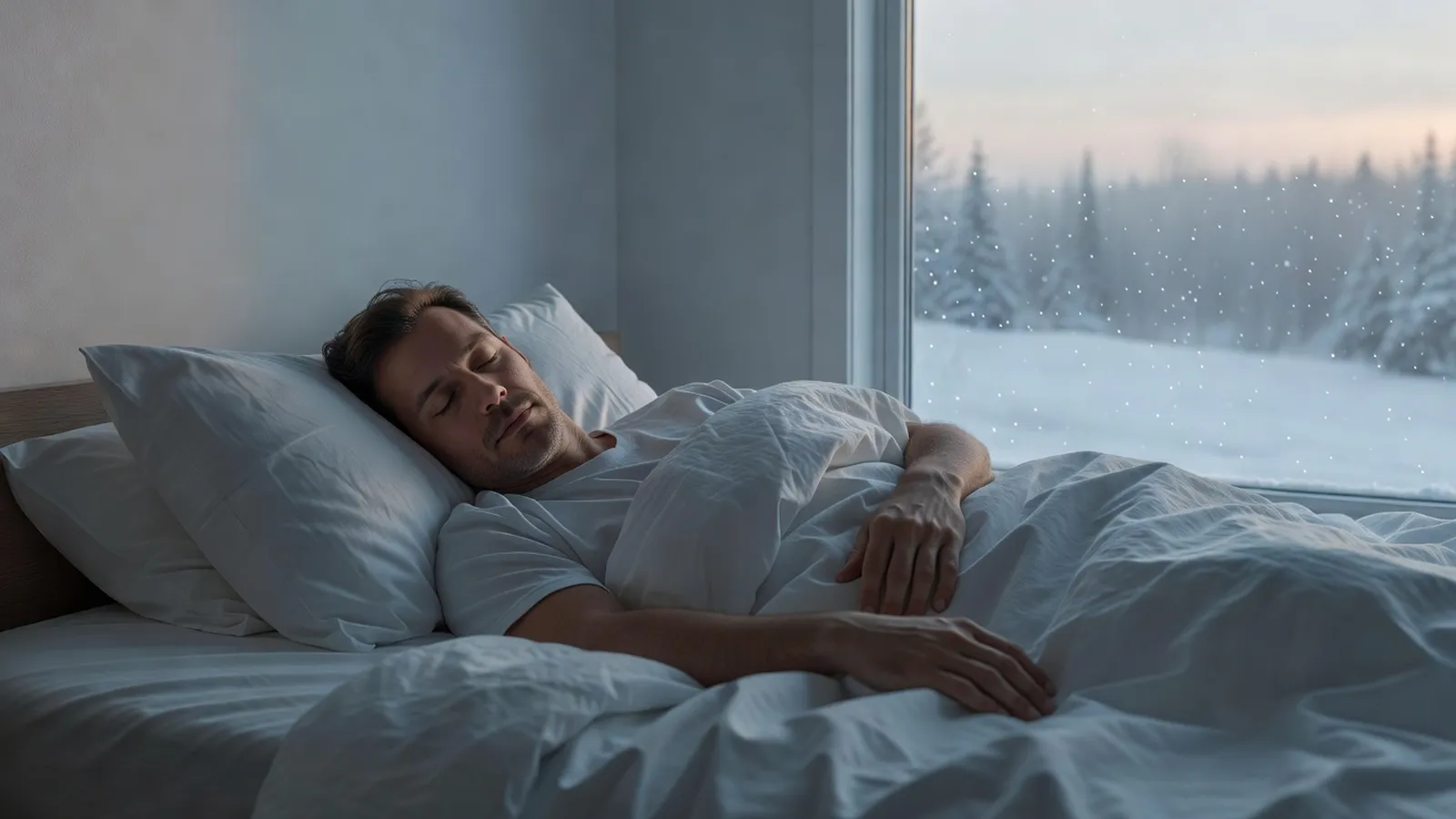
Stress and sleep influence each other in a loop that most people recognise from experience: a hard day makes it difficult to fall asleep, and a short night makes the next day's worries feel heavier. This page explains the link in plain terms, summarises what Canadian public sources say about sleep, looks at what changes through a Canadian winter and during travel, and describes habits that are commonly suggested for steadier rest. It is general information, not a diagnosis or a programme, and it does not replace advice from a physician or another licensed health professional.
In this guide
Three articles go deeper into this topic:
- Staying well while travelling: posture, sleep and jet lag
- Sleeping better through the Canadian winter: light, routine and the bedroom
- Interview: a sleep educator on stress and rest
How stress and sleep feed each other
When you are under pressure, your body stays more alert: heart rate and muscle tension can stay elevated, and your mind keeps rehearsing what is unresolved. At bedtime, that alertness can make it hard to switch off. Poor sleep then reduces patience, concentration and mood the next day, which makes ordinary demands feel larger, and the cycle continues. Understanding this loop is useful because it shows that there are two places to intervene: the stress during the day and the conditions for sleep at night.
It also helps to separate a rough night from a pattern. Everyone has bad nights, and one or two do not mean that something is wrong. A pattern of difficulty falling asleep, waking in the night or waking too early, lasting for weeks and affecting daytime functioning, deserves attention and often a conversation with a health professional. The sections below give practical reference points, and the final sections explain when to seek help.
What Canadian sources say about sleep
The Canadian 24-hour movement guidelines, summarised on a Public Health Agency of Canada page, recommend that adults aged 18 to 64 get 7 to 9 hours of good-quality sleep per night, with consistent bedtimes and wake-up times. For adults aged 65 and over, the recommendation is 7 to 8 hours. The same guidelines recommend limiting sedentary time to 8 hours or less per day and recreational screen time to 3 hours or less, which shows that sleep is treated as one part of a day that includes movement and rest.
Statistics Canada, using 2020 data, reported that adults aged 18 to 64 slept an average of 7.9 hours per night, that 77% met the recommended sleep duration and that 18% slept less than the recommended amount, generally fewer than 7 hours. These figures describe self-reported sleep in a survey, and they should not be read as a statement about any one person. They do suggest that most adults in Canada reported sleeping within the recommended range, and that a substantial minority did not.
| Age group | Recommended sleep (Canadian guidelines) | Other 24-hour guidance for adults |
|---|---|---|
| 18 to 64 years | 7 to 9 hours per night | Sedentary time 8 hours or less; recreational screens 3 hours or less |
| 65 years and over | 7 to 8 hours per night | Same limits for sedentary time and recreational screens |
Duration is only one part of the picture. Regularity, the feeling of being rested and the absence of long awake periods in the night also matter, and a person can sleep eight hours and still feel unrested if sleep is fragmented. If your sleep is noisy, with loud snoring, pauses in breathing noticed by a partner or choking during the night, mention it to a physician, because those can point to a sleep disorder that needs assessment.
Habits commonly suggested for better sleep
Public health and clinical sources tend to converge on a set of habits often called sleep hygiene. They are modest, and they work better as a package than as a single trick.
- Keep regular times for going to bed and waking up, including on days off, as far as your life allows.
- Get daylight early in the day, because morning light helps set the body clock.
- Keep the bedroom dark, quiet and a comfortable temperature, and reserve the bed for sleep.
- Limit caffeine in the afternoon and evening, and be cautious with alcohol, which can fragment sleep even if it helps you fall asleep.
- Keep a wind-down routine in the last hour before bed, away from work messages and bright screens.
- If you cannot sleep after a while, get up, do something quiet in low light and return to bed when sleepy, rather than lying awake watching the clock.
These are not guaranteed fixes, and they do not replace care for a sleep disorder. A Transport Canada guide on sleep hygiene, written for aviation personnel, illustrates how seriously rest is treated in jobs where fatigue matters, and its general advice is similar to the list above. Our article on sleeping better through the Canadian winter applies these ideas to light, routine and the bedroom.
The Canadian winter: light, routine and mood
Winter in much of Canada means short days, long dark commutes and less time outdoors. Some people notice that they sleep more, feel heavier or lose energy and interest through the season. For a smaller number of people, the change is more serious and is described as seasonal affective disorder. A technical report from the National Research Council of Canada cites an estimate that about 2.6% of Ontarians may experience a winter pattern of the disorder, which is a regional estimate from a particular study and not a national figure.
Practical habits can help many people feel steadier through the season, without any claim that they correct a medical condition. Getting outside in daylight, even on a grey day, keeps some of the benefit of natural light, and a regular schedule gives the body clock a steady reference. Staying physically active, even with short walks, and keeping contact with other people also matter. If low mood, loss of interest, changes in appetite or sleep, or thoughts of self-harm last for more than a couple of weeks, or are severe, a physician or a mental health professional should be consulted, and in a crisis, an emergency number or a provincial crisis line should be used.
Travel, time zones and jet lag
Crossing several time zones, which is common for people travelling from Canada to Europe or Asia, temporarily misaligns the body clock with local time. The Centers for Disease Control and Prevention describe jet lag in its travellers' health information and give general advice on adjusting. Common themes in such advice include adjusting your schedule gradually where possible, using daylight at the destination to help your clock shift, staying hydrated and being cautious with alcohol and caffeine. We do not discuss dosing of any supplement or medication on this page, and if you consider using one, a pharmacist or physician can advise you according to your health and other medications. Our article on staying well while travelling expands on posture and sleep during trips.
Evidence-based help for persistent sleep difficulty
When insomnia lasts and affects daily life, the approach best supported by quality standards is not a pill or a gadget. Ontario Health's quality standard for insomnia disorder states that people with insomnia disorder should have timely access to cognitive behavioural therapy for insomnia, often abbreviated CBT-I, as first-line treatment, delivered in a way that fits the person's needs and preferences. The same document describes medication as an option offered at the lowest possible dose for the shortest time, as part of a comprehensive plan. Ask your physician about CBT-I and about how to access it in your province, since availability varies.
If you have tried habits for a few weeks without improvement, or if you also notice low mood, anxiety, pain or snoring, a health professional can help find what is contributing. Sleep problems often accompany other conditions, and treating one without the other may not be enough.
Where manual therapies fit, and where they do not
Massage and gentle manual methods are sometimes chosen as a way to relax before sleep. Some people report feeling calmer after a session, and relaxation can be a reasonable, low-risk goal. It is important to be honest about the evidence: we did not find a body of high-quality studies showing that any manual therapy improves insomnia or is a recommended treatment for it. Our page on the Bowen technique and our page on massage therapy in Canada describe what research does and does not show for those approaches.
If relaxation after a session is something you value, see it as that, and keep the evidence-based basics of sleep in place. Be especially cautious about any claim that a technique, a device or a supplement will end insomnia or remove stress for good. Our page on what the evidence says about health claims gives a short list of warning signs.
Stress at work and at home
Stress is not only an inner state; it often reflects load, control and support at work and at home. Sources from workplace health agencies describe how demands, a lack of control and a lack of support can combine to make stress harder to bear. Small changes in the situation, such as clearer boundaries around after-hours messages, regular breaks or a conversation with a manager or family member about load, can reduce stress at the source. When stress is accompanied by anxiety, panic, low mood or burnout, support from a physician, psychologist or counsellor is a legitimate and effective step, and many employers offer an assistance programme.
A few quick, low-cost practices are often suggested for moments of tension: slow breathing, a short walk outdoors, stretching, writing down the tasks on your mind before bed, or a call with someone you trust. None of these is a medical intervention, and none needs special equipment. Our page on movement and posture looks at the physical side, including how a workstation affects tension.
A simple two-week experiment
If you want a structured way to look at your own sleep without making it a project, you can keep a short sleep diary for two weeks. Each morning, write down roughly when you went to bed, how long it took to fall asleep, how often you woke, when you got up and how rested you feel on a scale you invent. Add a line about caffeine, alcohol, evening activities and stress. At the end, look for patterns: are bad nights linked to late meals, long screen time or a hard day? Do they cluster around particular days of the week?
The diary has two uses. It helps you see which small change might be worth trying, and it gives a physician or other professional a clear picture if you decide to seek help. Change one thing at a time, for example a fixed wake-up time or an earlier end to caffeine, and give it a couple of weeks before judging. If sleep remains poor, or if you notice other symptoms, share the diary and ask for an assessment rather than adding more experiments.
When to seek medical help
See a physician if sleep difficulty lasts for several weeks and affects your days, if you are very sleepy while driving or at work, if you or a partner notice loud snoring with breathing pauses, if your mood is low for a long period, if you use alcohol or other substances to sleep, or if you have thoughts of harming yourself. Seek urgent help in an emergency. Medical advice is also important before using a sleep aid regularly, especially if you take other medications or have a chronic condition.
Caffeine, alcohol, naps and screens
Four everyday habits come up in nearly every conversation about sleep. Caffeine stays in the body for hours, so a late coffee, tea or energy drink can make it harder to fall asleep even if you do not feel wired; many people do better by stopping caffeine in the early afternoon. Alcohol can make you drowsy at first but tends to fragment sleep later in the night, so an evening drink is not a sleep aid. Naps can be refreshing, but a long or late nap can reduce the pressure to sleep at night, so keeping naps short and earlier in the day is a common suggestion for people who struggle at bedtime.
Screens raise two separate issues. The content can keep your mind busy, with messages, news or work, and bright light in the evening can delay the signal to wind down. Putting devices out of the bedroom, or at least away from the bed, and choosing something calm for the last half-hour of the day are simple changes that cost nothing. They are not magic, and some people sleep fine with a screen on, but they are reasonable experiments, and the two-week diary described above is a good way to see whether they matter for you.
Sleep and the Canadian calendar: shift work, daylight saving and travel
Canadian life brings its own rhythm changes. Clocks move forward in spring and back in autumn in most of the country, and for several days afterwards many people feel slightly out of step. Gentle habits help more than dramatic ones: keep your usual wake-up time, get outdoors in daylight soon after waking, and avoid making up for a short night with a long nap late in the day.
Shift work is common in health care, transport, resource industries and retail. Because the body clock is strongly tied to light, people who work nights tend to find sleep harder to protect. Practical steps that are often suggested include keeping the bedroom dark and quiet, using the same pre-sleep routine whatever the time of day, limiting caffeine to the first part of a shift, and talking to a physician if sleep problems persist or if you feel unsafe driving home. None of this replaces personal medical advice, but it gives you something concrete to try and to discuss.
Long winters add another layer. Short days and long commutes in the dark can lower energy and mood for some people. Seeking morning light, staying physically active and keeping social contact are widely recommended basics. If low mood is persistent, interferes with daily life or comes with thoughts of self-harm, contact your physician or a crisis line promptly; this guide is not the right place to look for help with that.
Finally, travel across time zones can disturb sleep for several days. Shifting your schedule gradually before a trip, exposing yourself to daylight at your destination and keeping meals at local times are common suggestions from public health agencies. Approach them as experiments and observe what works for your own body.
Key takeaways
Stress and sleep interact, and both can be addressed at several points. Canadian guidelines recommend 7 to 9 hours of good-quality sleep for adults aged 18 to 64, and Statistics Canada data from 2020 indicate that most adults reported meeting this, while about 18% reported less. Regular routines, morning light and a calm wind-down are commonly suggested habits. For persistent insomnia, quality standards point to cognitive behavioural therapy for insomnia as first-line care. Manual therapies may feel relaxing but are not an established treatment for sleep problems, and medical help should not be delayed when symptoms are serious or persistent.
Frequently asked questions
How much sleep do adults need?
The Canadian 24-hour movement guidelines recommend 7 to 9 hours of good-quality sleep per night for adults aged 18 to 64, and 7 to 8 hours for adults aged 65 and over, with regular bedtimes and wake-up times.
Do most Canadians get enough sleep?
In 2020 data from Statistics Canada, adults aged 18 to 64 slept an average of 7.9 hours per night, 77% met the recommended duration and 18% slept less than recommended. These are survey figures, not statements about one person.
Does winter affect sleep and mood?
It can. Short days and less time outdoors affect many people, and a smaller number experience seasonal affective disorder. If low mood or sleep changes last more than a couple of weeks or are severe, see a health professional.
What helps with persistent insomnia?
Ontario Health states that people with insomnia disorder should have timely access to cognitive behavioural therapy for insomnia as first-line treatment. Ask your physician how to access it in your province.
Can massage or manual therapy fix poor sleep?
It may feel relaxing, but we found no high-quality body of evidence showing that manual therapies improve insomnia. Keep the evidence-based basics and see a physician if the problem lasts.
Sources
Verified on
- Agence de la santé publique du Canada, Key findings: Physical Activity, Sedentary Behaviour and Sleep (PASS) Indicators, Gouvernement du Canada, 2026.
- Statistique Canada, Catching zzz's on World Sleep Day, Statistique Canada, 2026.
- Conseil national de recherches du Canada, Rapport technique sur le trouble affectif saisonnier, NRC Publications Archive, 2026.
- Ontario Health, Insomnia disorder: quality standard (énoncé 4, TCC de l insomnie en première intention), Ontario Health (Qualité), 2026.
- CDC, Jet lag (Travelers Health), Centers for Disease Control and Prevention, 2026.
- Transports Canada, Sleep hygiene: a guide to better rest, Gouvernement du Canada, 2026.
- CAMH, Sleep disorders: treatment, Centre de toxicomanie et de santé mentale, 2026.
- Cochrane, Workplace interventions (methods) for reducing time spent sitting at work, Cochrane, 2018.
- CCHST / CCOHS, Office ergonomics, Centre canadien d'hygiène et de sécurité au travail, 2026.