
Staying well while travelling starts with a realistic plan, not a perfect posture or a promise of uninterrupted sleep. Build room for position changes, protect a reasonable sleep opportunity and use the destination clock to organize your arrival. Jet lag is a temporary mismatch between daily rhythms and a new time zone, usually after crossing more than three zones. Preparation can reduce avoidable friction, but it cannot guarantee how alert or rested anyone will feel.
Start with the parts of travel you can control
A travel day combines several demands: getting to the terminal, waiting, sitting, carrying belongings, finding food and adapting to unfamiliar sleeping conditions. Trying to optimize every detail can make the plan harder to follow. It is more useful to identify a few choices that remain available even when a gate changes or a connection runs late.
Begin with timing. An itinerary that looks efficient on a booking screen may leave little room for eating, changing position or winding down before bed. Consider the entire day rather than the scheduled time in the air. Ground transportation, security procedures and the trip from the arrival point to accommodation all form part of the practical load.
Next, decide what must remain accessible. Water, required medication, identification, an extra layer and any simple sleep accessories should not be buried where reaching them requires repeated twisting or unloading a bag. This is an organizational choice rather than a medical intervention, but it can make a confined seat easier to manage.
Separate preferences from necessities. You may prefer a quiet seat or a particular departure time, yet your essential needs could involve mobility assistance, access to prescribed medication or enough time between connections. Naming those priorities before booking helps distinguish a tolerable inconvenience from an arrangement that does not work for you.
Travel also sits within the broader relationship between stress and sleep. A complicated departure can occupy attention long before bedtime. A short written list, prepared documents and a clear plan for the first evening can reduce the number of decisions left for a tired arrival, without promising that sleep will follow on command.
Finally, leave some flexibility. Weather can disrupt Canadian departures, distances between terminals can be substantial, and accommodation may differ from its description. A plan with alternatives is more durable than one that depends on every stage unfolding exactly as expected.
A compact plan for each stage
The table below is a planning tool rather than a schedule everyone must follow. Adapt it to the length of the trip, your mobility, the available space and any advice already provided by your health professional.
| Stage | Main practical question | A simple option | What not to assume |
|---|---|---|---|
| Before booking | Does the itinerary leave workable time for rest and transfers? | Compare the whole travel day, not only flight duration | The shortest itinerary will necessarily feel easiest |
| Before departure | Which routine is realistic to preserve? | Protect a reasonable sleep opportunity and prepare essentials early | A major last-minute schedule change will suit everyone |
| At the terminal | Have you been in one position for a long period? | Change position or walk when practical and permitted | A precise movement interval fits every traveller |
| While seated | Can your body and belongings fit without repeated strain? | Support your feet where possible and keep needed items close | One rigid posture must be held throughout |
| During an overnight segment | What conditions can you adjust? | Reduce avoidable disturbance with comfortable clothing and simple accessories | Travel sleep will resemble sleep at home |
| After arrival | Which local cues can organize the day? | Use the destination clock for planned activities and bedtime | Alertness will adjust immediately |
| First night | Is the room workable for rest? | Address light, noise and temperature within your control | An unfamiliar room will feel normal at once |
| Return home | Does the home schedule also require adjustment? | Leave room to re-establish ordinary routines | Only the outbound trip affects timing |
This framework deliberately avoids a universal walking interval, a prescribed sleep schedule or a fixed amount of water. Needs differ, and the supplied Canadian and CDC guidance does not provide one travel formula for every person. Practical guidance should remain practical rather than acquiring false precision.
The plan should also fit the purpose of the trip. A holiday, a work visit and travel for caregiving may create very different first-day demands. If the arrival day is crowded, decide in advance which tasks can wait. If the schedule is fixed, identify small pauses that do not depend on having a completely free afternoon.
Avoid turning preparation into a test of discipline. A delayed departure does not mean the plan has failed. Return to the next available decision: how to sit, what to keep accessible, when to stop adding tasks and how to arrange the upcoming sleep opportunity.
For posture, favour variation over rigidity
A seat can limit how much you move, but posture is not a single correct shape. Body size, mobility, clothing, luggage placement and seat design all affect what is workable. The useful question is not, “Am I sitting perfectly?” It is, “Can I remain supported and change position without creating another problem?”
Start at the floor. If your feet reach a stable surface, let that surface carry them rather than holding the legs in tension. If they do not, use an available support that is permitted and does not obstruct the space. Avoid placing a large personal item where it forces your feet into an awkward position for the entire seated period.
Arrange the seat before settling in. Remove bulky objects from pockets if they make the pelvis uneven. Place frequently needed items where they can be reached without a deep twist. Adjust layers early so that changing temperature does not require a complicated search through an overhead bag.
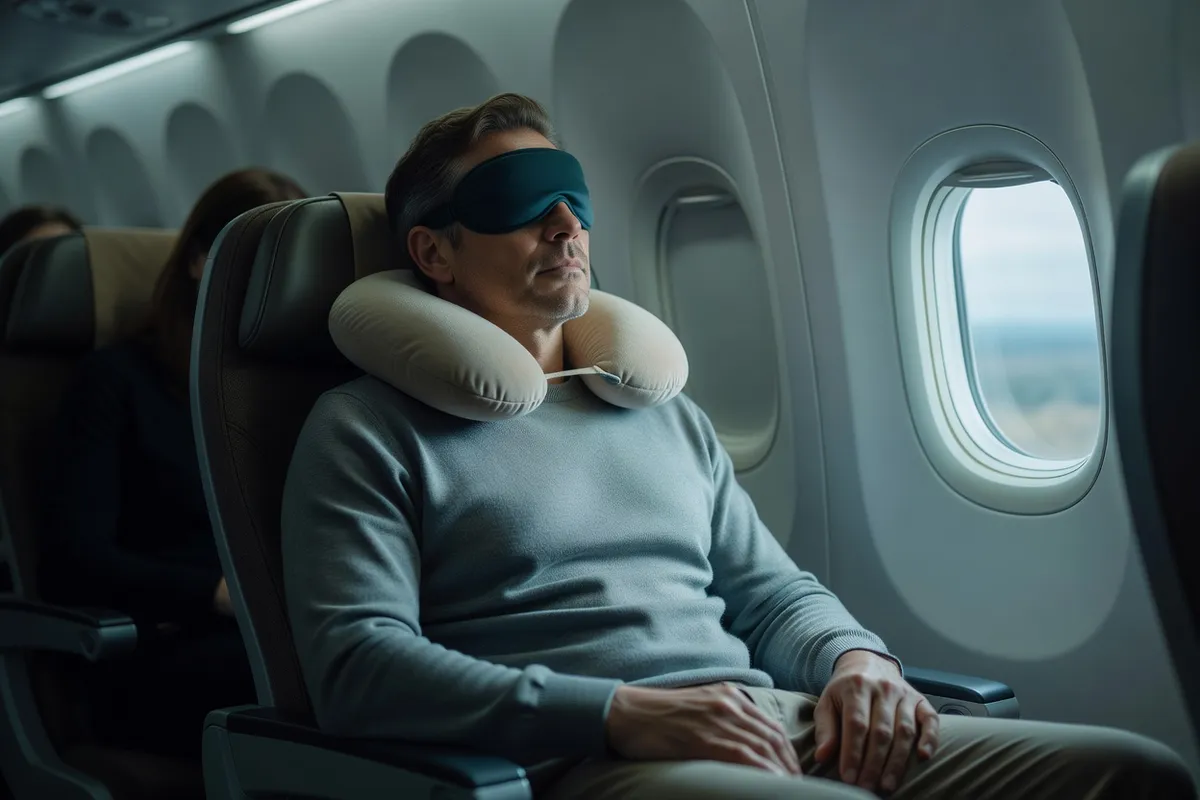
Let the backrest provide support rather than hovering forward for long stretches. A small personal support may feel useful to some travellers, but it is not mandatory and should not force the spine into an uncomfortable curve. The same caution applies to neck pillows: shape, fit and sleeping position matter more than the product label.
Screens deserve attention because they can draw the head and shoulders forward. Bring a personal screen toward a comfortable viewing position when the setup permits, rather than repeatedly bending toward a device held low. For reading, alternate how the material is supported instead of gripping it in one position indefinitely.
Variation can be modest. Reposition the feet, uncross and recross the legs if comfortable, relax the hands, or change the angle of the backrest when allowed. Standing or walking may also be an option when conditions permit. There is no need to claim that a specific sequence or frequency works for everyone.
Movement must remain compatible with the travel setting. Do not improvise in a way that blocks an aisle, interferes with another passenger or conflicts with crew instructions. If you use a mobility aid or need assistance, arrange the relevant support through the carrier rather than relying on generic seat advice.
Pay attention to how carrying continues after arrival. A bag that is manageable for a short distance may feel different across a large terminal, on winter pavement or while transferring to public transportation. Wheels, balanced packing and fewer unnecessary items are logistical choices that can reduce avoidable handling.
Posture guidance has limits. A long-standing mobility issue, recent procedure or other health concern changes the context. General suggestions cannot determine what movement or support is appropriate for an individual situation; that question belongs with a physician or licensed health professional familiar with the person’s health.
Jet lag is a clock mismatch, not a personal failure
The CDC’s 2026 Travelers’ Health page on jet lag describes it as a disagreement between a person’s daily rhythms and the new time zone. It is a temporary sleep problem that generally occurs after travel across more than three time zones. The CDC also notes possible effects on mood, concentration and performance.
That definition matters because it places the experience in timing rather than willpower. Feeling unable to sleep at the destination bedtime does not mean someone has prepared badly. Likewise, waking earlier than planned does not establish that a particular routine has failed. The body and the local clock may not yet be aligned.
Not every trip crosses enough time zones to fit that description. An early departure, an overnight seat or an unusually long day can still leave a traveller feeling tired. Avoid labelling every difficult travel night as jet lag. The distinction can keep expectations proportionate and discourage unnecessary experimentation with products.
The CDC says travellers may adjust their schedules during the few days before departure. This is an option, not an obligation. Work shifts, school, caregiving and family meals may make advance changes impractical. A preparation strategy should not demand so much disruption that it removes ordinary sleep before the trip begins.
If an adjustment is feasible, keep it understandable. Look at the destination bedtime and wake time, compare them with the home schedule and decide whether a modest advance change fits daily responsibilities. Avoid inventing a minute-by-minute protocol. The goal is to make the transition less abrupt, not to guarantee a symptom-free arrival.
Once at the destination, use local time as the main organizing reference. Set clocks correctly, confirm the day’s commitments and decide when the planned sleep period begins. Meals, activity and social plans can then be considered in relation to that local schedule and to personal needs.
Do not expect an immediate subjective response. A traveller may be able to follow the destination clock while still feeling sleepy, distracted or unusually awake. Since the CDC identifies mood, concentration and performance as areas that may be affected, it is sensible to avoid treating the first day’s alertness as a reliable measure of preparation quality.
A demanding arrival deserves extra planning. If possible, do not make every important decision immediately after landing. Where the schedule cannot be changed, use written information, reminders and confirmation from the relevant travel provider rather than depending entirely on memory while tired.
Protect sleep opportunity without chasing perfect sleep
Canadian guidance offers a useful baseline for ordinary adult sleep. The Canadian Society for Exercise Physiology’s 2026 movement guidelines recommend seven to nine hours of good-quality sleep for adults aged 18 to 64, along with regular bedtimes and wake times. That is a general health target, not a promise about a night in transit.
Travel planning can protect the opportunity for sleep even though it cannot produce sleep on demand. An overnight itinerary may involve announcements, seat changes, unfamiliar sounds and interruptions. Instead of judging the night against ideal bedroom conditions, identify what can reasonably be made quieter, darker or more comfortable.
Simple accessories may help create a familiar routine. An eye covering, ear protection, a comfortable layer or a small personal item can signal that the active part of the day is ending. Choose items you already tolerate. A new accessory discovered to be uncomfortable after departure is not useful merely because it was marketed for travel.
Keep the wind-down sequence short enough to repeat. Wash, change layers, silence avoidable notifications and place morning essentials together. This can work in a hotel, a family home or another temporary setting. The sequence is valuable as organization even when sleep remains uneven.
A Canadian winter departure can complicate familiar routines through dark mornings, bulky clothing and rapidly changing travel conditions. The companion guide on sleeping better through the Canadian winter considers the bedroom and daily routine in that seasonal context. For travel, focus on preserving a few familiar cues rather than reproducing home exactly.
Caffeine, alcohol, meals and personal habits may influence how an individual experiences bedtime, but this article does not prescribe quantities or timing rules. Make deliberate choices based on your established routine, health context and responsibilities at the destination. Do not use a crowded travel day to test an unfamiliar sleep strategy.
If a nap fits the itinerary, consider how it relates to the planned sleep period rather than following a universal duration. A nap may be impossible, unwanted or disruptive for a particular traveller. The practical question is whether it supports the day’s schedule, not whether it matches a generic travel checklist.
For a conversational review of routines and realistic expectations, the interview with a fictional sleep educator explores stress and rest without offering individual therapeutic advice. It can be useful when the challenge is less about a single flight and more about the pressure to sleep perfectly.

Make the first local day easy to understand
Arrival can be disorienting because several basic questions appear at once: What time is it locally? When is the next commitment? Where are essential items? When does the planned sleep period begin? Answer these questions before adding optional activities.
Change devices and watches to the destination time, then confirm any bookings that depend on a particular date. This sounds elementary, but overnight travel and date changes can make a familiar calendar feel less obvious. Keep reservation details together so that checking them does not require searching several applications while tired.
Use a small number of anchors for the first day. These might include accommodation access, a planned meal, an essential call and bedtime. They are not a biological protocol. They simply turn an unfamiliar day into a sequence that can be followed without making constant decisions.
Build a settling-in period if the itinerary permits. Unpack what is needed for the night, identify the bathroom, check the alarm and prepare clothing for the next morning. A calm setup can prevent practical tasks from accumulating at the moment you intend to sleep.
Be conservative about optional commitments. A full first evening may look appealing when planned from home, yet concentration and performance can be affected by jet lag according to the CDC. If an activity matters, make its timing, location and transportation clear in advance. If it does not matter, consider leaving it flexible.
For work travel, distinguish attendance from high-stakes performance. Some meetings cannot move, but supporting material can be prepared before departure. Written agendas and notes reduce the need to reconstruct details from memory. This is good organization regardless of how quickly the traveller adapts.
For a holiday, avoid treating the first day as lost if energy is uneven. A simpler schedule is still part of the trip. The purpose of local-time planning is to provide structure, not to enforce productivity.
The return deserves the same attention. Home obligations may restart immediately, especially after long-distance travel to Canada. Check transportation, groceries, caregiving and the next workday before departure. A modest re-entry plan can be more useful than assuming familiar surroundings will instantly restore routine.
Keep movement in the wider picture
The same Canadian movement guidelines recommend at least 150 minutes of moderate-to-vigorous activity each week, muscle strengthening at least twice weekly and limits on sedentary time for adults aged 18 to 64. These are weekly health guidelines, not instructions to perform vigorous activity in a terminal or confined seat.
Travel can interrupt an established routine, but a disrupted day does not erase the broader pattern. Consider how ordinary movement can resume around the trip: walking during a suitable part of the day, using available facilities or returning to usual activities after arrival. The appropriate choice depends on the setting, weather, mobility and personal health.
Avoid compensating dramatically for a seated travel day. A demanding workout undertaken solely to “make up” for sitting is not required by the guideline. Its recommendations are framed across the week and alongside sleep and sedentary behaviour. A balanced plan remains more coherent than swinging between prolonged inactivity and an unfamiliar level of exertion.
During travel itself, take opportunities to change position when they are safe, permitted and compatible with your needs. No exact interval is provided in the supplied guidance, so this article does not invent one. A phone alarm that is impractical during sleep, turbulence or a border process is not automatically better than noticing natural transition points.
Those transition points may include arriving at the gate, stopping during a road trip, waiting for luggage or settling into accommodation. Use the environment that actually exists. In severe weather or an inaccessible terminal, indoor options may differ from plans made at home.
The movement target also sits beside the sleep target. Sacrificing a realistic sleep opportunity to complete an arbitrary travel exercise plan misses the integrated nature of the Canadian guidance. For a broader discussion of that relationship, return to the stress and sleep overview.
Know where general guidance stops
Most travel planning advice assumes that a person can sit, stand, carry belongings and alter a schedule without individualized restrictions. That assumption does not fit everyone. Existing health conditions, disability, pregnancy, prescribed medication, recent medical care or substantial mobility needs may require a different plan.
This article cannot assess those factors. Speak with a physician or licensed health professional when a personal health question affects the itinerary. Contact the carrier directly for operational questions such as mobility assistance, seating arrangements or transporting medical equipment. Health guidance and carrier procedures answer different questions.
Persistent or concerning symptoms should not be attributed automatically to posture, poor sleep or jet lag. Those labels are broad and cannot establish what is happening in an individual case. Seek appropriate assessment rather than relying on an online checklist to interpret a new health concern.
Be equally cautious about products presented as essential for travel. This guide does not recommend medications, supplements, special pillows or wearable devices. A product may be unnecessary, unsuitable or simply uncomfortable for a given person. Marketing language is not a substitute for evidence or individualized advice.
For official Canadian background on sleep, the Public Health Agency of Canada published “Canadian adults getting enough sleep” in 2019. Transport Canada’s 2026 sleep-hygiene guide is directed to aviation personnel, so its professional context should not be mistaken for a personalized passenger plan.
A reusable checklist for the next trip
Several days before departure, review the destination time zone and decide whether a modest schedule adjustment is feasible. Protect ordinary sleep rather than forcing a complicated change. Confirm the complete itinerary, including ground travel, and place essential documents and required medication where they remain accessible.
When packing, choose clothing that permits comfortable position changes and layers that can be adjusted. Reduce unnecessary weight. Plan where a personal item will sit so that it does not take all available foot space or require repeated awkward reaching.
On the travel day, use natural pauses to stand, walk or change position when practical and permitted. Support the feet, vary seated posture and bring screens toward a workable viewing position. Keep expectations for sleep proportionate to the environment.
After arrival, switch to the destination clock, identify a few local-time anchors and prepare the sleeping space before fatigue makes small tasks feel complicated. Keep the first schedule understandable and leave optional activities flexible.
On returning home, repeat the process rather than assuming that only outbound travel requires planning. Re-establish regular sleep and activity patterns as daily responsibilities allow. The aim is not complete control over alertness, posture or sleep. It is a travel plan with fewer avoidable obstacles and enough flexibility to remain useful when conditions change.
Frequently asked questions
What is the best posture for a long flight?
There is no single seated position that everyone must maintain. Aim for a supported, workable posture: place your feet on a stable surface when possible, keep essential items within easy reach and avoid twisting around luggage. Change position periodically when conditions permit. Comfort, mobility, seat design and personal health needs all affect what is practical.
How is jet lag different from simply feeling tired after travelling?
According to the CDC, jet lag is a temporary sleep problem caused by a mismatch between daily rhythms and the new time zone, generally after crossing more than three time zones. Travel can also feel tiring for practical reasons, including an early departure or interrupted rest. A tired feeling alone does not identify its cause.
Should I change my sleep schedule before departure?
The CDC says adjusting schedules during the few days before departure is possible. Whether that is practical depends on work, caregiving and departure times. A modest shift may be easier to fit into ordinary life than a major change. If preparation would reduce your sleep opportunity, a steady routine may be the more realistic priority.
How much sleep should an adult plan for while travelling?
Canadian movement guidelines for adults aged 18 to 64 recommend seven to nine hours of good-quality sleep, with regular bedtimes and wake times. Travel may make that target difficult on a particular night. It can still serve as a planning reference when selecting flights, arranging the first evening and leaving space for rest.
Does this guide recommend a medication, supplement or travel remedy for jet lag?
No. This guide focuses on schedules, sleep conditions, posture and practical planning. It does not recommend medications, supplements or other products. Questions about whether a specific product is appropriate require individual assessment, especially when health conditions or existing medications are involved. A physician or licensed health professional can address that personal context.
Sources
Verified on
- CDC, Jet Lag, Centers for Disease Control and Prevention (Travelers' Health), 2026.
- CDC, Jet lag (Travelers Health), Centers for Disease Control and Prevention, 2026.
- Transports Canada, Sleep hygiene: a guide to better rest, Gouvernement du Canada, 2026.
- Agence de la santé publique du Canada, Canadian adults getting enough sleep (infographic), Gouvernement du Canada, 2019.
- SCPE / CSEP, Canadian 24-Hour Movement Guidelines for Adults (18-64), Société canadienne de physiologie de l'exercice, 2026.