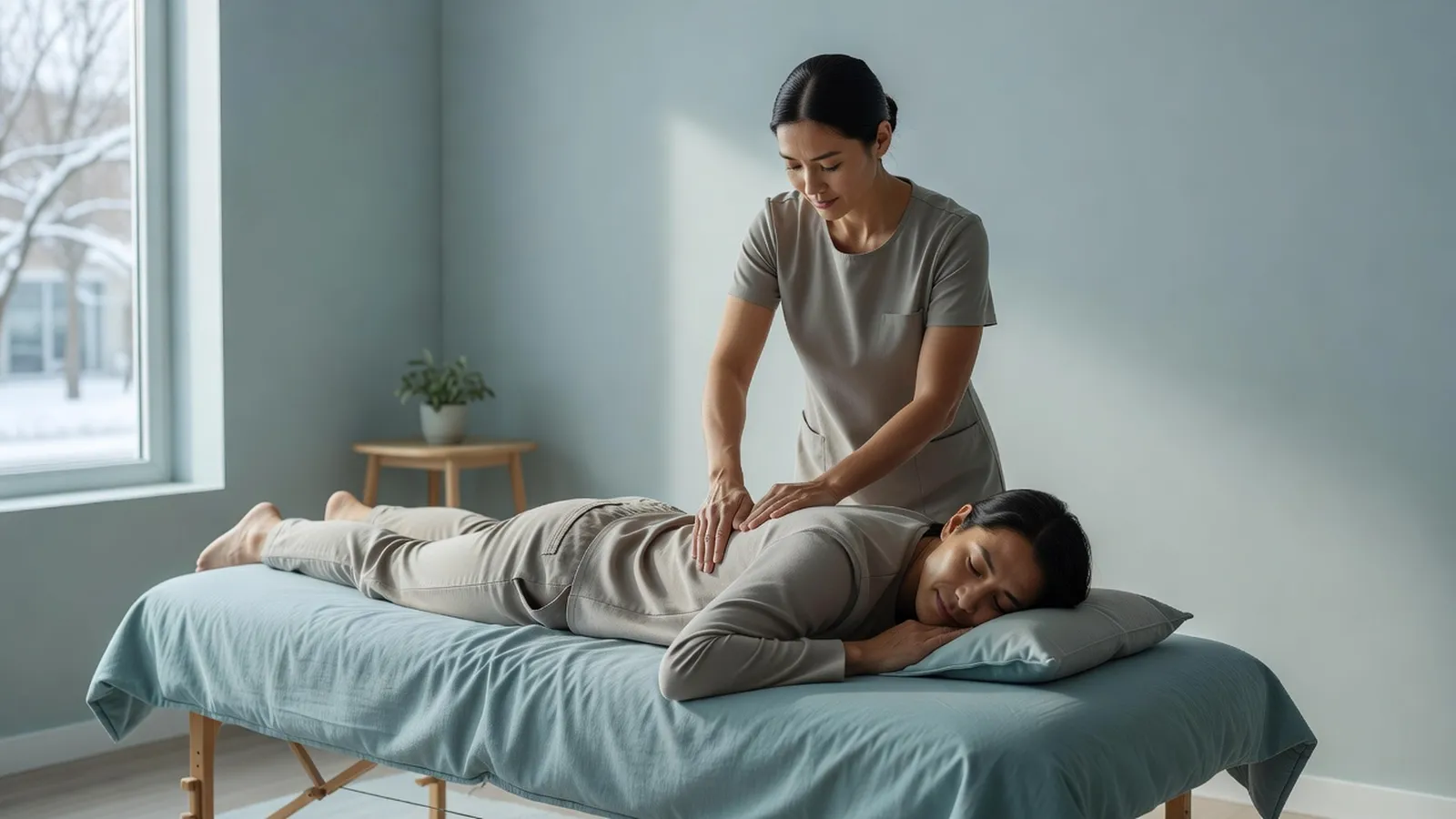
The Bowen technique is a gentle, hands-on method built from small, rolling moves applied through light clothing, with pauses between sequences. It is practised in Canada and many other countries, and it attracts curiosity because a session can look almost too light to matter. This page explains where it comes from, what a session typically involves, what published research can and cannot tell us, and how to approach it as an informed adult. It is general information, not advice about your own situation, and it makes no promise about any result.
In this guide
Three articles go deeper into this topic:
- Tom Bowen and the history of the Bowen technique
- What to expect at a Bowen session
- Interview: a Bowen practitioner on the pause between moves
Where the technique comes from
The method is named after Tom Bowen, an Australian who, according to the dates generally cited, lived from 1916 to 1982. He had no formal medical training and developed his way of working on his own before it was taught to students and spread abroad. We have no reliable first-hand writing from him, so much of the early history is oral and passed through students. That matters for a reader: the story of the technique is partly tradition, and traditions are not evidence.
After his death, several groups of students formed training schools and associations, each with its own name, curriculum and emphasis. You may see the words Bowen technique, Bowen therapy, Bowenwork or a brand name for a specific school. They share a common core of moves but are not governed by a single Canadian regulator. The practical consequence is simple: a practitioner's training can range from a short weekend course to a long, structured programme, and the label alone does not tell you which. If you want to read the history in more depth, our guide to Tom Bowen and the history of the technique goes into the sources and the points where accounts differ.
What a session typically involves
Descriptions of a session are fairly consistent across schools, which is helpful because it lets you recognise what you are being offered. You usually stay clothed, wearing something light, and lie on a treatment table or sit on a chair. The practitioner makes small, rolling moves with the thumbs or fingers over muscle, tendon or connective tissue at specific places on the body. The moves are brief and light compared with a deep-tissue massage.
The distinctive feature is the pause. After a short sequence of moves, the practitioner leaves the room or steps back for a few minutes, so that the person on the table is left undisturbed. Schools explain this interval in different ways, and no explanation has been established by research. For a reader, it is enough to know that it is part of how the method is delivered and that you can ask the practitioner what they do during the pauses and why.
A first appointment may include a short conversation about your health history, your reasons for coming, any medical diagnoses and any medications you take. A responsible practitioner will tell you plainly that the method does not replace medical care, will not ask you to stop a treatment prescribed by a physician, and will suggest you see a doctor if something sounds like it needs a medical assessment. Our guide on what to expect at a Bowen session walks through the sequence step by step.
| Question | What is commonly described | What to keep in mind |
|---|---|---|
| Do I undress? | No, light clothing is usual | Ask about the setup when you book |
| How hard is the touch? | Light, rolling moves | Report discomfort at once |
| Why the pauses? | Schools give different explanations | None is established by research |
| How long is a session? | Often under an hour | Varies by practitioner |
| Is a diagnosis made? | Not by a Bowen practitioner as such | Medical diagnosis belongs to a physician |
What the research actually shows
The most useful way to read the research is to separate three questions: how much of it exists, how good it is, and what it measured. A systematic review published in 2011 by Hansen and Taylor-Piliae searched the literature on Bowenwork up to September 2009 and found 309 citations. Only 15 articles met their inclusion criteria, and among those, a single study was a randomized clinical trial; the others were quasi-experimental, mixed-methods, cross-sectional or case studies. The authors concluded that the technique may be a non-invasive complementary approach but that scientific evidence was not well documented and that more research was needed. That is a careful sentence, and it is worth reading slowly: it is neither an endorsement nor a dismissal.
Since then, a few more randomized trials have appeared. A 2011 trial by Marr and colleagues, from a physiotherapy school in the United Kingdom, looked at hamstring flexibility over time after Bowen sessions. A 2023 trial published in the International Journal of Therapeutic Massage and Bodywork randomized 90 people with myofascial neck pain to eight sessions of a Bowen-based method over twelve weeks or to their usual conventional care. A 2024 trial in the Pakistan Journal of Medical Sciences compared the Bowen technique with a muscle energy technique in 62 people with chronic low back pain and hamstring tightness. Each of these studies has a specific design, a specific outcome measure and a specific population, and none of them can be generalised into a statement that the method works for a condition. Small samples, short follow-up, difficulty blinding people to a hands-on method and the strong effect of attention and expectation are standard cautions in manual therapy research.
Two points help in reading headlines. First, a trial that finds a difference in a measurement, such as a range of motion, does not necessarily show a difference in how a person feels or functions in daily life. Second, a trial that compares a method with doing nothing cannot distinguish the method itself from the benefit of being cared for, lying down for an hour and expecting to feel better. Those effects are real and are not shameful, but they are not specific to Bowen. A government health information service in Victoria, Australia, describes Bowen therapy for the public and advises choosing a registered therapist, which is a sensible, practical note rather than a claim about effectiveness.
What it is and is not: a plain-language summary
Putting the evidence together, the honest summary is modest. There is a small, growing body of studies, a limited number of randomized trials and no robust evidence base establishing the method as an effective approach for any particular condition. Some people report that they feel relaxed or more comfortable after a session, and the method is generally described as gentle. Those two statements can both be true without implying that it is a recommended option for a medical problem.
It also helps to say what the technique is not. It is not a diagnostic method. It is not a substitute for physiotherapy, medical imaging, surgery, medication or psychotherapy when those are indicated. It is not a way to manage a serious or fast-changing health problem. If you are curious about it, see it as a complementary experience, with a clear view of what you are paying for and what you can expect.
Safety, cautions and when to see a doctor first
Because the touch is light, the method is generally regarded as low-risk for healthy adults, but low risk is not the same as no risk, and individual situations differ. Some reasonable precautions apply to any manual approach.
- Tell the practitioner about any diagnosed condition, recent injury, surgery, pregnancy or medication, and about anything that is new or worsening.
- Do not use any manual therapy as a reason to delay assessment of sudden, severe or unexplained symptoms, such as chest pain, sudden weakness or numbness, loss of bladder or bowel control, unexplained weight loss, fever with severe pain, or a head injury.
- Do not stop or change a treatment prescribed by a physician without discussing it with that physician.
- Stop the session and speak up if something hurts or feels wrong.
Our overview of chronic pain and the limits of complementary approaches says more about when persistent pain deserves a medical assessment before anything else. If you are weighing the technique against other manual therapies, the page on massage therapy in Canada explains how a regulated profession differs from an unregulated method, and why that distinction affects what you can expect from the person you consult.
Choosing a practitioner in Canada
In Canada, regulation of health professions is a provincial matter, and the situation for the Bowen technique is different from that of regulated professions such as physiotherapy or, in some provinces, massage therapy. To our knowledge, Bowen practice is not a regulated profession with a protected title of its own, and you can confirm that with the college of your province. Some practitioners are also regulated health professionals, for example physiotherapists or regulated massage therapists, and they are accountable to their college for that role; others practise only the Bowen technique and answer to a voluntary association, if any.
That does not make a practitioner unreliable, but it does change what you should check. Useful questions include the following.
- What is your training, how long was it, and with which school or association?
- Are you also registered with a provincial regulatory college for another profession? If so, which one, and can I verify it in the public register?
- What do you do when a person's situation needs a medical assessment?
- What will the session cost, how long is it, and what are your cancellation terms?
- How do you describe what the technique can and cannot do?
A trustworthy answer is clear, specific and modest. A warning sign is a promise: statements that the method will resolve a diagnosed condition, that it can replace a prescribed treatment, or that a long series of sessions is needed to get results. Our page on what the evidence says about health claims offers a short list of warning signs that apply to any practitioner. For public registers of regulated professions in British Columbia, a provincial health information service lists the main colleges and their searchable registers, and you can check a title there before you book.
Costs, coverage and practical matters
Prices vary by region and by practitioner, so this page gives none. Coverage under extended health benefits depends on the contract, and many plans reimburse only services provided by a practitioner in a recognised regulated profession or a member of an association the insurer lists. A practitioner who is also, for instance, a regulated massage therapist may be able to issue a receipt under that profession, but the receipt must reflect the service genuinely provided. Check your plan documents or ask your insurer before you rely on reimbursement, and keep in mind that the rules differ between plans.
Plan the visit as you would any appointment. Wear comfortable, light clothing, avoid a heavy meal just before, and write down your questions in advance. Afterwards, note how you feel over the following days, including anything unexpected, and share it with your usual health professional if it is relevant. If you have a long-standing problem, keep the medical follow-up you already have.
Reading the claims you will find online
Search results about the Bowen technique mix several kinds of content: material from training schools and associations, clinic pages, personal stories, and a smaller amount of independent scientific literature. The first three are not neutral, because they come from people with an interest in the method. Personal stories are sincere, but a story cannot show whether a change would have happened anyway. Be especially careful with pages that list a long catalogue of conditions the method is said to help, because the research does not support such lists.
A useful habit is to look for four things when you read a claim: who is making it, what they are selling, what kind of study they cite, and whether the study measured something that matters to you. A claim backed by an actual published trial, with named authors, a journal and a year, is easier to check than one backed by the phrase studies show. When you find a study, read what it measured, how many people it included and how long the follow-up lasted. If you cannot find those details, treat the claim as unproven.
How it fits with the rest of a well-being routine
A manual session, of any kind, is one small part of looking after yourself. Habits that are better documented as supports for well-being include regular movement through the week, a stable sleep routine, time outdoors in daylight during the Canadian winter, and a workstation that suits your body. Our pages on stress and sleep and on movement and posture cover those themes with sources. If a gentle, hands-on session is something you enjoy and can afford, there is nothing wrong with choosing it as a way to rest, as long as you do not expect it to do the work of medical care.
Finally, keep your expectations proportionate. If you try the technique and feel relaxed, that is a good enough reason for some people to return. If you do not notice anything, that is also a normal and informative result. In neither case should the experience change what you do about a medical symptom: that remains a conversation to have with a physician or another licensed professional.
Questions worth asking before a first session
A few plain questions make a first appointment easier and protect you from disappointment. Ask how the practitioner was trained, with which school or association, and whether that body keeps a public list of members. Ask what a typical session looks like and how many sessions are usually suggested, then notice whether the answer is a range with room for your own judgement or a fixed package presented with urgency. Ask whether the practitioner also holds a regulated health title, because some do, and whether they will work alongside your physician or physiotherapist rather than in place of them.
It is also reasonable to ask what the practitioner will do if you feel worse, or if nothing changes. A thoughtful answer includes stopping, adjusting and referring you elsewhere. A practitioner who regards any such question as a sign of doubt or bad faith is giving you useful information about how the relationship would go. Write down your questions beforehand, bring a list of any medications and diagnoses, and keep a short note of how you feel in the days after, so that you can describe it accurately at the next visit.
Finally, remember that you are free to try one session and decide afterwards. Nothing in this guide suggests that you must continue, and nothing in the research suggests that more sessions are automatically better.
Key takeaways for readers
The technique is gentle, developed in Australia by Tom Bowen, and described consistently across schools: light moves, clothing kept on, pauses between sequences. The research is limited, with one randomized trial among the 15 studies in a 2011 systematic review and a few more trials since, none of which establishes the method as an effective approach for a specific condition. In Canada, to our knowledge it is not a regulated profession with its own protected title, so checking a practitioner's training and any separate regulated registration is your responsibility. See it as a complementary experience, ask direct questions, and keep your medical care where it belongs.
Frequently asked questions
Is the Bowen technique regulated in Canada?
To our knowledge it is not a regulated profession with its own protected title. Some practitioners also belong to a regulated profession such as physiotherapy or massage therapy, which you can verify in the public register of the provincial college.
What does a session involve?
Typically light clothing, small rolling moves with the thumbs or fingers at specific places and pauses between sequences. Schools explain the pauses differently, and no explanation has been established by research.
Does research show that it works?
The evidence is limited. A 2011 systematic review found one randomized trial among 15 articles, and a few more trials have appeared since, none of which establishes the method as effective for a specific condition.
Can I use it instead of seeing a doctor?
No. It is not a diagnostic method and does not replace medical assessment. See a physician for sudden, severe or unexplained symptoms, and do not stop a prescribed treatment without discussing it with the prescriber.
Will my insurance reimburse it?
It depends on your contract. Many plans reimburse only regulated professions or associations they recognise. Ask your insurer which credentials it accepts before booking.
Sources
Verified on
- Hansen C, Taylor-Piliae RE, What is Bowenwork? A systematic review, The Journal of Alternative and Complementary Medicine, 2011.
- Marr M, Baker J, Lambon N, Perry J, The effects of the Bowen technique on hamstring flexibility over time: a randomised controlled trial, Journal of Bodywork and Movement Therapies, 2011.
- Carter B, Clients' experiences of frozen shoulder and its treatment with Bowen technique, Complementary Therapies in Nursing and Midwifery, 2002.
- Chee LAY et al., The effect of ISBT-Bowen therapy in the treatment of myofascial neck pain: a randomized, single-blinded clinical trial, International Journal of Therapeutic Massage and Bodywork, 2023.
- Batool K, Mehmood M et al., Comparative efficacy of muscle energy technique and Bowen technique on hamstrings muscle tightness in chronic low back pain patients, Pakistan Journal of Medical Sciences, 2024.
- Better Health Channel, Bowen therapy, Gouvernement de l'État de Victoria, Australie, 2026.
- NCCIH, Complementary Health Approaches for Chronic Pain, National Center for Complementary and Integrative Health (NIH), 2026.
- CCHPBC, About the College (titres réservés / reserved titles), College of Complementary Health Professionals of British Columbia, 2026.
- HealthLink BC, College of Health and Care Professionals of BC, Government of British Columbia, 2026.
- Bureau de la concurrence du Canada, Health and medical scams, Gouvernement du Canada, 2026.