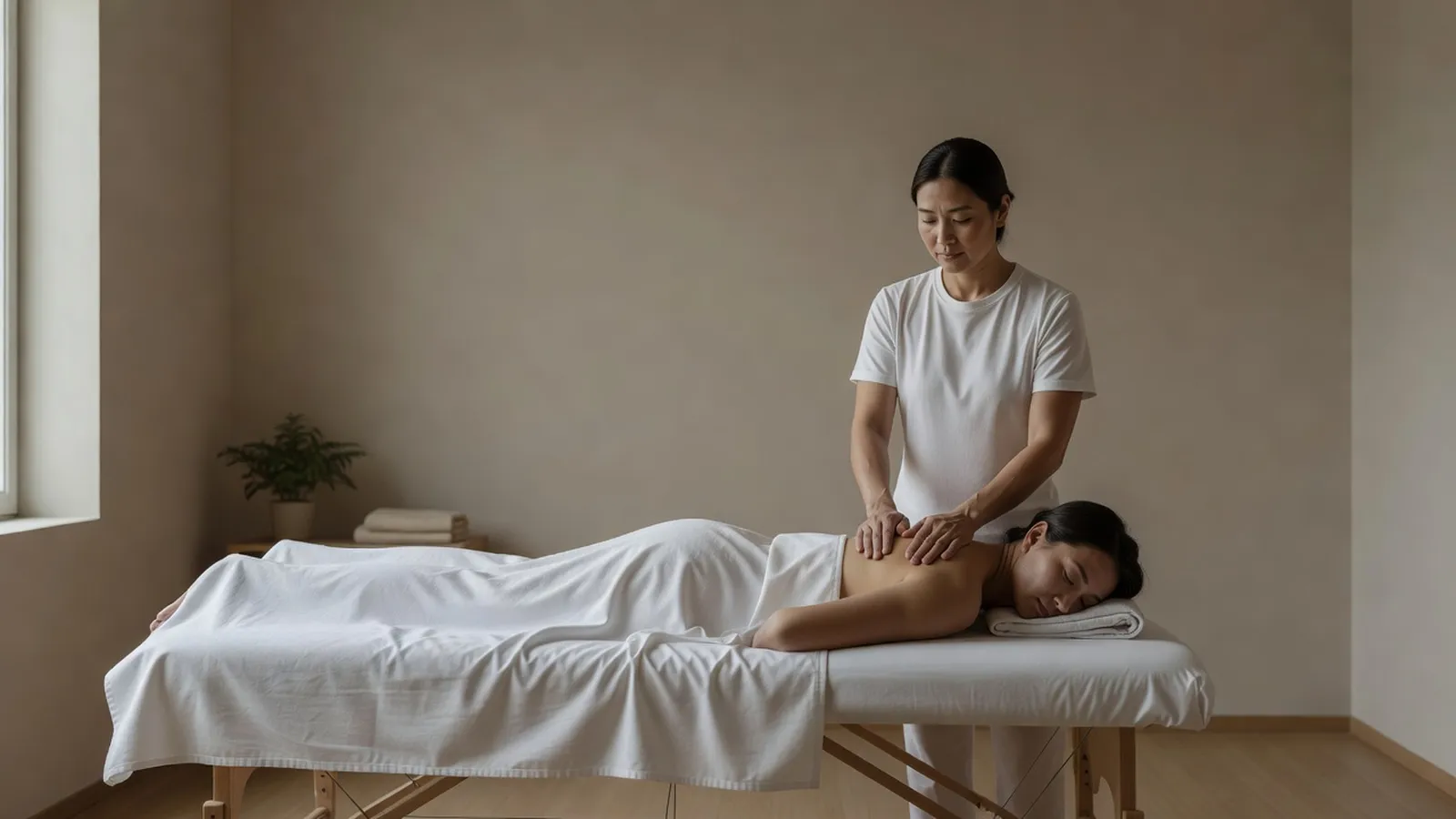
Massage therapy is one of the most familiar manual therapies in Canada, and also one of the most confusing to navigate, because the rules differ from one province to the next. In one province, the title massage therapist is protected by law and tied to a regulatory college. In another, the title may not be linked to a college at all. Extended health benefits add another layer: whether you are reimbursed depends on your contract, not on the quality of the massage. This page explains how regulation works in British Columbia, Ontario and Quebec, what insurance plans typically look at, what research says about massage and back pain, and what to check before you book. It is general information, and the regulatory details reflect sources consulted on 26 November 2026; rules change, so confirm with the college or authority of your province.
In this guide
Three articles go deeper into this topic:
- Massage therapy in B.C. and Quebec: how regulation differs
- Extended health benefits and massage: how reimbursement works
- Interview: a massage therapist on what a first appointment looks like
Why regulation matters to you
When a profession is regulated, a provincial college sets the standards for entry to practice, keeps a public register, receives complaints and can discipline members. A reserved title, such as Registered Massage Therapist, means that only people who meet the college's requirements and are registered may use it. For a member of the public, the practical value is verification: you can look a person up and see whether they are registered, instead of relying on a certificate on a wall.
Regulation does not guarantee a good experience, and an unregulated practitioner is not automatically unsafe. But it changes what you can verify and who is accountable. The distinction is especially useful when you are choosing someone to work on a painful area, when you have a medical condition, or when you want to claim the cost under an insurance plan.
British Columbia: the college and the protected titles
In British Columbia, massage therapists are regulated by the College of Complementary Health Professionals of British Columbia, known as the CCHPBC. According to the college and to a provincial government page, the CCHPBC was formed on 28 June 2024 by the amalgamation of four colleges, among them the College of Massage Therapists of British Columbia, which is therefore no longer the separate regulator of the profession. If you are reading older articles or an older insurance form that mentions the former college, this is the reason the name looks out of date.
The CCHPBC states that only its licensees may use the titles Registered Massage Therapist, abbreviated RMT, and a small set of related titles, including Massage Therapist, Registered Massage Practitioner and Massage Practitioner. The legislation changed as well: the college reports that the Health Professions and Occupations Act replaced the earlier Health Professions Act on 1 April 2026. The practical advice is to check the current register of the college rather than rely on a printed credential.
The provincial Medical Services Plan also touches massage therapy. According to the provincial page, which showed an update date of 3 October 2026, massage therapy is covered only for beneficiaries who have supplementary benefits status, and it shares a combined limit of 10 visits per calendar year with several other professions. Eligibility rules and wording can change, so read the current page if this matters to you. For most people, extended health plans, rather than the provincial plan, are the main route to reimbursement.
Ontario: a protected title and the college
In Ontario, massage therapy is regulated by the College of Massage Therapists of Ontario, or CMTO. The college's policy on titles explains that Registered Massage Therapist and Massage Therapist are protected titles, reserved for people registered with the college who have met its entry-to-practice requirements. If you see someone using those titles in Ontario, you can ask for their registration number or look them up in the college's public register.
The same policy points to a general concern worth remembering: titles and credentials that are unclear or inconsistent make it hard for the public to tell whether a person is a regulated health professional. A string of letters after a name can be a university degree, a certificate from a private school or a membership in a voluntary association. The words themselves do not tell you which, and only the register of a college can confirm a regulated status.
Quebec: a different structure, to be checked at the source
In Quebec, the professional system is organized around professional orders governed by the Professional Code, and the Office des professions du Québec oversees the system. To our knowledge at the time of writing, massage therapy is not governed by a professional order under the Professional Code in Quebec, which means the title massothérapeute is generally not protected in the way Registered Massage Therapist is in British Columbia or Ontario. We were not able to read the Office's list of orders for this page, because the site blocked our automated check, so we present this as a point to verify rather than as a confirmed statement. The Office publishes the list of professional orders, and you can confirm there whether any order covers massage therapy.
In practice, practitioners in Quebec often belong to voluntary associations, which set their own standards for training and ethics and may be recognised by insurers. A membership is a signal worth asking about, but it is not the same as being governed by a professional order, and an association does not have the legal powers of a college. If you are choosing a practitioner in Quebec, ask about the training, the association and whether the insurer you rely on recognises it. Our guide to massage therapy regulation in British Columbia and Quebec lays out the comparison in more detail.
| Province | Regulator | Protected title | How to verify |
|---|---|---|---|
| British Columbia | CCHPBC (formed 28 June 2024) | RMT, Massage Therapist, RMP, MP | CCHPBC register |
| Ontario | CMTO | RMT, Massage Therapist | CMTO public register |
| Quebec | No order confirmed for massage; to be verified | Not confirmed | Office des professions list of orders |
Extended health benefits: what insurers usually look at
Extended health benefits, offered by many employers and some individual policies, often include a line for massage therapy. We did not find a primary public source that sets out conditions or amounts that apply across the country, so we give none. What can be said is general: plans differ, many ask that the practitioner be a member of a regulated college or of an association the insurer recognises, limits per year or per visit are set by the contract, and some plans require a referral or a note from a physician. Your plan booklet or the insurer's member site is the authoritative source.
Practical steps help avoid unpleasant surprises. Before booking, ask the insurer which credentials it recognises for massage therapy, whether it needs the practitioner's registration number on the receipt and whether there is an annual maximum. Ask the practitioner what information the receipt will show. Keep every receipt, because insurers often require a complete one. Do not ask a practitioner to issue a receipt that does not match the service provided: that is not appropriate, and it can jeopardise your claim. Our article on extended health benefits and massage goes into the questions to ask your insurer.
What research says about massage
Massage is one of the better-studied manual therapies, mainly for back pain, and the findings are measured. A Cochrane review of massage for low-back pain by Furlan and colleagues, published in 2015, reported that massage may bring short-term improvement in pain for some comparisons, and it rated the overall evidence as low or very low in quality. A Canadian guideline from the Ottawa Panel, published in 2012 by Brosseau and colleagues, concluded that massage could provide short-term improvement for subacute and chronic low-back pain symptoms, especially when combined with therapeutic exercise and education, which is not the same as high-certainty evidence.
For fibromyalgia, a 2014 meta-analysis in PLoS ONE by Li and colleagues did not conclude that massage is an established effective option. Taken together, the research suggests that massage may be a pleasant, low-risk way to feel more comfortable for a while, that its measured effects are generally short-term and modest, and that it does not replace active care or medical assessment. Our page on chronic pain puts these findings in the larger picture of persistent pain, and our page on movement and posture looks at the active side.
What a first appointment looks like
A typical first appointment includes a short health history, a conversation about your goals and any conditions or medications, and an explanation of what will happen. You undress only to your comfort level and are draped with a sheet or towel, and the practitioner uncovers only the area being worked on. You can ask for lighter or firmer pressure, and you can stop at any time. A regulated practitioner is expected to obtain your informed consent and to respect your privacy and boundaries.
A few signs should prompt you to reconsider: pressure that is painful and ignored when you ask for less, a request to undress beyond what you are comfortable with, comments that make you uneasy, or sales pitches for supplements or long prepaid packages. If anything of this kind happens, you can end the session. If you wish to report a regulated practitioner, the college of the province is the place to do so.
Who should check with a physician first
Massage is generally considered low-risk for healthy adults, but some conditions call for medical advice before booking, or for a modified approach. Examples include a recent injury or surgery, a suspected blood clot or unexplained swelling in a limb, certain skin conditions, an infection with fever, pregnancy, bleeding disorders, anticoagulant medication and cancer or cancer care. A regulated massage therapist is trained to ask about these, but your own doctor knows your history best.
Medical attention should not wait if you have sudden severe pain, chest pain, shortness of breath, loss of strength or feeling, or loss of bladder or bowel control. In those cases, a massage appointment is not the right step. Our page on chronic pain lists more warning signs.
Titles worth recognising, and others to question
Alongside massage therapist, you may meet terms such as bodyworker, wellness practitioner, therapeutic touch practitioner, structural integration practitioner or the name of a specific method. Some of them describe real, careful practices; others are marketing labels. The point is not that unregulated practitioners are untrustworthy, but that the label alone says nothing about training, accountability or insurance recognition. Related professions, such as physiotherapy and chiropractic, have their own regulators and titles, and a public register tells you whether a person holds them.
For public registers in British Columbia, HealthLink BC lists the main colleges and links to their registers, including the College of Health and Care Professionals of BC, which keeps a register covering professions such as physiotherapy and psychology. Our page on what the evidence says about health claims explains how to weigh promises about any practitioner.
A short checklist before you book
- Where do you practise, and what is your regulatory status in this province? Can I verify it?
- What is your training, and which association, if any, do you belong to?
- Will the receipt meet my insurer's requirements, and what is the cost and the cancellation policy?
- How do you handle consent, draping and privacy?
- What do you do if my situation needs a medical assessment?
A clear, patient answer to these questions is a good sign. A reluctance to answer, or an insistence on a long package, is a reason to look elsewhere.
Practical tips for booking and arriving
Booking is easier when you know what you want to get out of the visit. Decide whether you are looking for general relaxation or for help with a specific area, and say so when you call. Ask about the length of the appointment, because the time includes the health history and a short conversation at the end. Ask what the clinic's cancellation policy is, and whether there is a fee for a missed appointment.
On the day, arrive a few minutes early with a list of your medications and any diagnoses. Wear comfortable clothing and avoid a large meal immediately beforehand. During the session, tell the therapist about pressure, temperature and any area you would prefer they avoid, and mention anything unusual in the hours or days afterwards, such as soreness that is stronger than expected. Mild soreness can happen after a firm session, but pain that is severe, sharp or lasting is a reason to contact the practitioner and, if needed, a physician.
Finally, keep your own records: the date, the practitioner's name and registration number, the amount paid and the receipt. These details make it easy to claim under your plan, to follow up with the practitioner and, if something goes wrong, to file a complaint with the right college.
Questions about privacy, consent and boundaries
A good massage appointment rests on clear consent, and you are entitled to it at every stage. Before the session begins, the therapist should explain what they plan to do, which areas they will work on, and how you will be draped. You can ask for changes, ask them to stop, or end the session at any time, without having to justify yourself. A professional will check in about pressure and comfort and will respect your answers the first time.
Health information you share, such as diagnoses, medications and injuries, is personal. Regulated practitioners work under professional and privacy obligations, and it is reasonable to ask how your records are kept and who can see them. If the answer is vague, or if you are asked to share more than seems relevant, that is worth noticing. The same applies to any sales pressure: a therapist who pushes a prepaid package at the first visit, or who makes health claims to justify it, is not following the careful tone that this guide recommends.
If something happens during a session that makes you uncomfortable, you may stop it, leave, and report it. Regulators in the provinces described above accept complaints about registered practitioners, and their public pages explain how the process works. In a province where the title is not protected, you can still contact the association the person claims to belong to, and, where relevant, the police or consumer protection authorities.
Finally, tell the therapist about anything that has changed since your last visit, such as a new medication, a recent injury or a pregnancy. Good care adjusts to the person on the table, and that depends on open communication in both directions.
Key takeaways
Regulation of massage therapy differs across Canada: in British Columbia the CCHPBC, formed in 2024, now regulates the profession and protects the title RMT; in Ontario the CMTO protects the same title; in Quebec, to our knowledge, no professional order covers massage, which makes checking training and association membership more important. Insurance reimbursement depends on your contract. Research suggests that massage may bring short-term comfort, with low-certainty evidence, and it does not replace medical assessment or active care.
Frequently asked questions
Who regulates massage therapists in British Columbia?
The College of Complementary Health Professionals of British Columbia (CCHPBC), formed on 28 June 2024 through the amalgamation of four colleges including the former College of Massage Therapists of British Columbia. Only its licensees may use the RMT title.
Is Registered Massage Therapist a protected title in Ontario?
Yes. According to the College of Massage Therapists of Ontario, Registered Massage Therapist and Massage Therapist are protected titles reserved for people registered with the college.
What about Quebec?
To our knowledge, massage therapy is not governed by a professional order under the Professional Code, but we could not read the Office des professions list directly. Check the list of orders and ask the practitioner about training and association membership.
Will my extended health plan reimburse massage?
It depends on your contract: many plans require a recognised credential, set yearly limits and ask for a complete receipt. We give no amounts; ask your insurer which credentials it recognises before booking.
Does research show massage works for back pain?
A 2015 Cochrane review reported possible short-term improvement in pain for some comparisons but rated the evidence as low or very low in quality. Massage may be comfortable, but it does not replace active care or a medical assessment.
Sources
Verified on
- CCHPBC, About the College (titres réservés / reserved titles), College of Complementary Health Professionals of British Columbia, 2026.
- CCHPBC, Health Professions and Occupations Act, College of Complementary Health Professionals of British Columbia, 2026.
- Gouvernement de la Colombie-Britannique, Professional regulation (health professions), Government of British Columbia, 2026.
- Gouvernement de la Colombie-Britannique, MSP supplementary benefits, Government of British Columbia, 2026.
- CMTO, Policy: Use of Titles and Credentials, College of Massage Therapists of Ontario, 2026.
- Office des professions du Québec, Les ordres professionnels, Gouvernement du Québec, 2026.
- HealthLink BC, College of Health and Care Professionals of BC, Government of British Columbia, 2026.
- Furlan AD, Giraldo M, Baskwill A, Irvin E, Imamura M, Massage for low-back pain, Cochrane Database of Systematic Reviews, 2015.
- Brosseau L, Wells GA, Poitras S et al., Ottawa Panel evidence-based clinical practice guidelines on therapeutic massage for low back pain, Journal of Bodywork and Movement Therapies, 2012.
- Li YH, Wang FY, Feng CQ, Yang XF, Sun YH, Massage therapy for fibromyalgia: a systematic review and meta-analysis of randomized controlled trials, PLoS ONE, 2014.