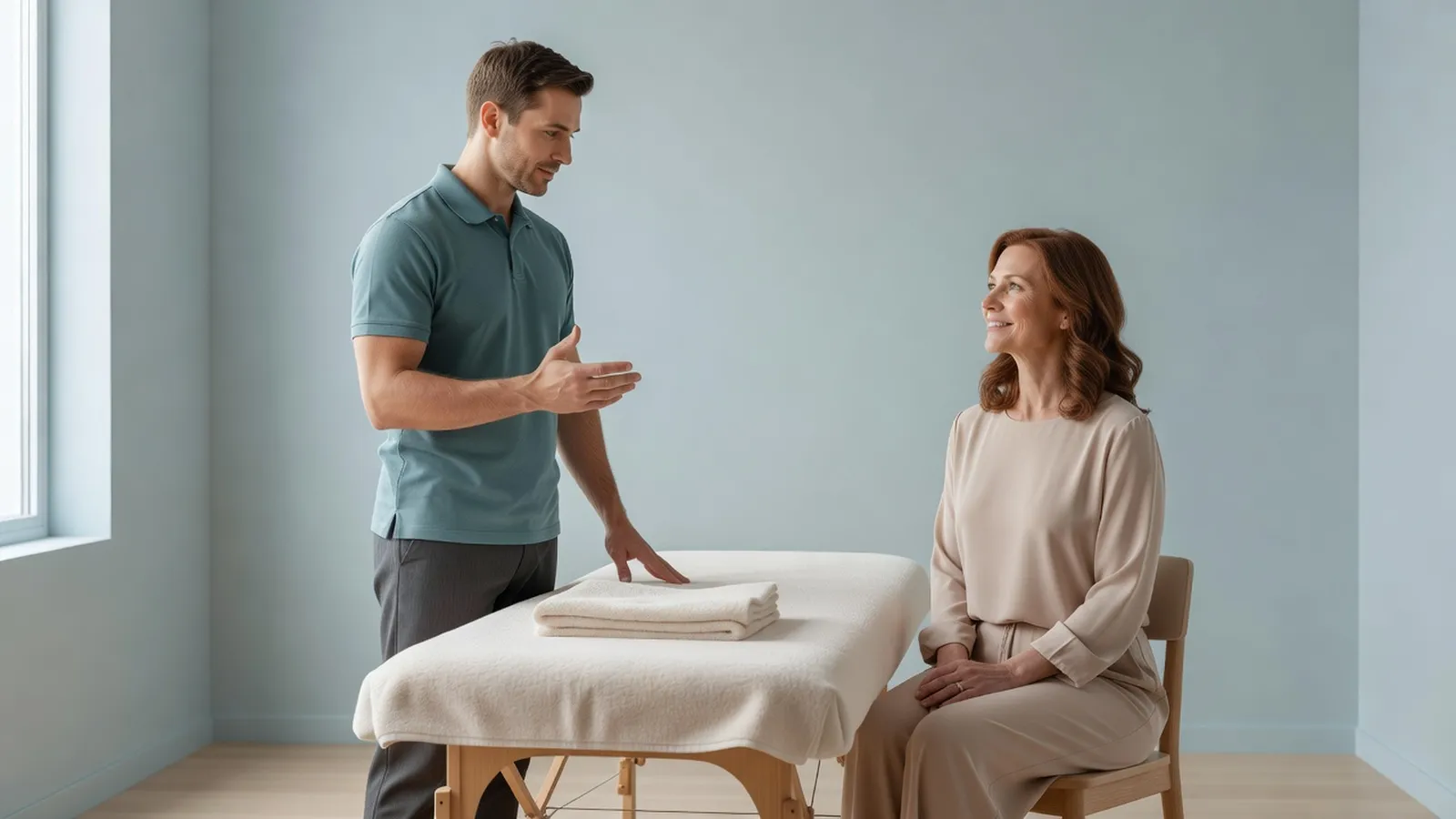

Marc-André Lefebvre
Massage therapy, an imagined expert for this guide, Gatineau
The views in this interview are those of a fictional expert created for this guide.
The following is an interview with a fictional expert, a massage therapist imagined for this guide, Marc-André Lefebvre, based in Gatineau. He does not exist, and his answers are not advice about your own situation, nor a practice's policies. They are written to illustrate what a careful first appointment can look like, using the facts documented in our sources, and to show the questions worth asking. Nothing here is a promise of any result.
Before the appointment
Many people feel nervous before a first appointment. Where do you start?
I start by saying that nervousness is normal and that you do not owe anyone a performance. Most of what makes a first visit comfortable happens before the session: understanding what will happen, knowing that you control the pace and having your questions answered. If you are unsure, I suggest phoning the clinic and asking a few practical things: how long the appointment lasts, what the setup is like, whether you can talk to the therapist beforehand and how payment works.
I also encourage people to think about why they are coming. Some want relaxation, some a break from a heavy workday, some are curious about a method they have heard about. It is perfectly reasonable to say, "I just want to see what it is like." There is no wrong reason, as long as nobody promises you a cure for something that needs medical attention.
What would you want a new client to find out in advance?
Three things. First, what the therapist's title means where you live, which I will come back to. Second, what your insurer recognizes, if reimbursement matters. And third, whether you have anything that calls for a conversation with a physician first. If you have a new, severe or unexplained symptom, a massage session is not the place to start. See a doctor, and then ask whether a gentle session is reasonable.
The conversation at the start
What happens when someone walks in?
We sit down. Before any hands-on work, there is a conversation about your health history, any diagnoses, medications, surgeries, injuries and what brings you in. I ask what you would like from the session and whether anything is off-limits. I explain what I plan to do in plain words, how I will use the table and the sheets and how you can tell me to change something.
It matters that this is a conversation, not a form to be filled in silently. People often mention something important in passing, such as numbness or a new medication, and that changes how I proceed. Health information is confidential, and I collect only what is needed to treat you safely.
Do you ever decide not to proceed with a session?
Yes, and it is part of doing the job responsibly. If someone describes symptoms that suggest a medical assessment should come first, such as sudden severe pain, fever, chest pain, unexplained weight loss or a recent injury that has not been looked at, I tell them plainly that I think they should see a physician, and I do not proceed until they have. That is not a lack of care; it is how care works. A manual therapist cannot diagnose or rule out serious conditions, and pretending otherwise would be unfair to the client.
Consent, draping and comfort
What do you mean when you say consent is ongoing?
I mean that agreeing at the start does not commit you for the whole session. The College of Massage Therapists of Ontario's standard on professional boundaries, draping and physical privacy asks therapists to monitor the patient's consent and comfort continuously during assessment and treatment. I like that wording because it makes consent a process. You can change your mind in the middle, and you do not need a reason. Our guide to massage therapy explains what a session usually involves.
In practice, I check in. I ask about pressure, about temperature, about whether a position is comfortable. And I tell clients that they can say "lighter", "pause", "stop" or "I would like to turn over" whenever they like. If someone goes quiet and tense, I notice and ask. Silence is not consent.
How do draping and clothing work?
I explain it before you undress, if you choose to undress at all. The same CMTO standard says that the therapist should discuss in advance how sensitive areas will be draped or clothed and how touch will occur, and that sensitive areas must never be exposed without informed consent. Many clients keep underwear on, some stay fully clothed for certain kinds of work, and some prefer a particular arrangement of sheets. You decide. I step out while you get settled on the table, and I knock before returning.
I will add a caution: the CMTO is the college in Ontario, and I mention its standard because it is a clear public statement of good practice. Rules and standards differ by province, so I always suggest that people read what the relevant college or association says where they live.
What the session feels like
What can a client expect physically?
It depends on the approach and on what we agreed. Swedish-style or relaxation massage uses broad, flowing strokes. Other work is more focused on particular areas. I adjust pressure according to what you tell me, and I would rather work lighter and build up than start too deep. Some people find it relaxing, some sleepy, some a bit sore afterwards in a muscle that was tense. Others notice little. All of these are common, and none is a measure of whether the session was worth it.
I avoid promising outcomes. Research on massage for conditions like back pain exists, and it is mixed, with benefits that tend to be small and short-term at best in the reviews I know. I would rather say honestly what I can offer, such as an hour of care that many people find relaxing, than overstate what it does.
What if a client feels uncomfortable?
They say so, and I adjust or stop. I mean that literally. A good session is not one where you endure something. If pain is sharp, if you feel exposed or anxious, or if something simply does not feel right, we change what we are doing. If a client wants to leave, I thank them and let them go without making them feel bad about it. A therapist who argues with a client who wants to stop is not someone to return to.
Titles, associations and insurance
You work in Quebec. How should clients think about your credentials?
That is a good question, and I want to be accurate. To our knowledge, massage therapy in Quebec is not governed by a professional order under the Professional Code; we could not read the official page to confirm it, so people should check the Office des professions' list of orders. If that is correct, there is no public register of the kind that exists in British Columbia or Ontario. So the questions shift: where did the therapist train, for how long, which association do they belong to, and what are that association's standards and complaint process?
I would encourage any client in any province to ask these things. In British Columbia, for example, the College of Complementary Health Professionals reserves titles such as Registered Massage Therapist to its licensees. In Ontario, the CMTO protects the titles Registered Massage Therapist and Massage Therapist. Those titles let a client verify registration. Where no order exists, you verify what you can and ask your insurer what it recognizes.
And insurance?
Reimbursement depends on the plan, not on what a therapist says. Many extended health plans recognize certain professions or associations, and some require a receipt with specific details. My advice is to call your insurer before you book, ask which credentials it accepts and what the receipt must show, and not rely on a clinic's assurance. If the insurer's answer is unclear, ask for it in writing.
Is it appropriate to bring a friend or to ask for a chaperone?
Yes. Some clients feel more at ease with a support person in the waiting room, or want to talk through the plan with someone beforehand. A good clinic will have no difficulty with that. If a client is nervous about a particular aspect, we simply change it: more clothing, a different position, a shorter first visit. There is no obligation to do everything in one appointment, and a first visit can be as simple as a conversation and a few minutes of work on the shoulders.
How do you handle privacy and records?
Health information is confidential, and I keep only what I need to work safely. In Ontario, the CMTO's standard on draping and physical privacy is a clear public statement of how consent and comfort should be handled. Privacy law differs by province, so I tell clients that they may ask what is kept, why and for how long. If a clinic cannot answer, that is information.
What if I am in pain and hoping massage will fix it?
I would gently slow us down. Persistent pain deserves a medical assessment, and a session of massage may be a comfort for some people but it is not a treatment that I can promise will change a condition. Reviews of massage for conditions such as low back pain describe benefits that are modest and short-term at best, with evidence of low quality. That is not nothing, but it should shape what you expect. If the pain is new, severe or unexplained, see a physician first. If you have a diagnosis, I would like to know it and I would encourage you to tell your physician what you are trying. Our overview of chronic pain lists questions to bring to an assessment.

How do you decide how many sessions to suggest?
I do not decide in advance. I would rather see how you feel after one session and talk about it than sell a series. If a client wants regular sessions as part of their routine, as some people do for relaxation, that is a personal choice and we can plan around their budget. If someone expects a particular result from a fixed number of sessions, I explain that I cannot promise it. A therapist who tells you exactly how many sessions you need to resolve a condition is claiming more certainty than the evidence supports.
How should a client tell whether a method is regulated where they live?
By checking the official source for the province: the College of Complementary Health Professionals of British Columbia explains the titles it reserves, and the CMTO publishes its policy on titles for Ontario. In Quebec, we suggest checking the Office des professions' list of orders and asking about associations. Be wary of any site that shows many logos and badges without naming a body you can look up. Our article on massage therapy regulation in B.C. and Quebec compares the provinces. The article on extended health benefits and massage explains how reimbursement works in general terms.
Questions I enjoy being asked
What questions from clients do you appreciate?
All of them, honestly. I enjoy "What is your training?", "What would you do if this hurt?", "What would make you say that I should see a doctor?" and "How many sessions do you think I would need?" The last one deserves a careful answer. I do not believe in selling large prepaid packages. I would rather a client come once, see how they feel and decide for themselves.
I also like being asked what massage cannot do. It cannot diagnose. It is not a replacement for medical care, physiotherapy, medication or psychotherapy when these are indicated. And it should not be sold with promises such as curing a disease. The Competition Bureau of Canada lists miracle cures and dramatic personal stories among the warning signs of health scams, and I think clients are wise to keep that in mind.
Any red flags clients should notice in a clinic?
Pressure to buy quickly, claims that a method treats a long list of unrelated conditions, discouraging you from seeing a physician or stopping medication, vague answers about training, no explanation of draping or privacy, and a therapist who does not seem to listen. Any one of these deserves a question; several together suggest finding another clinic. Our guide to choosing a manual-therapy practitioner in Canada goes through these signs in more detail.
After the session and the bigger picture
What do you tell clients at the end?
I check how they feel, offer a glass of water and give them time to sit up slowly. I may suggest drinking water and taking it easy for the rest of the day, as general comfort suggestions rather than instructions. I tell them what I noticed, in modest terms, and what I would suggest as a next step, if any. And I remind them that if anything worries them, such as unusual pain, numbness or a new symptom, they should contact a physician. I would rather they call than wait.
How does massage fit into a broader approach to well-being?
As one part, never the whole. Sleep, movement, stress, social support and medical follow-up matter at least as much. The titles, regulation and reimbursement questions above cover most of the practical context. For people living with persistent pain, I would point to a physician and to resources such as our overview of chronic pain.
If you could give a first-time client one piece of advice, what would it be?
Treat the first appointment as a conversation, not an exam. Ask what you want to ask, say what you are comfortable with, and remember that you can stop at any moment. If you leave feeling respected and informed, whether or not the session itself was exactly what you expected, it was a good first appointment. And if your symptoms are new, severe or unexplained, see a physician first.
Is there anything you wish clients did less of?
Apologize. People say sorry for being tense, for needing to adjust the sheet, for asking questions. There is nothing to apologize for. The session is for you, and the more you tell me, the better I can adapt. I would also gladly see fewer clients who push through discomfort to be polite, because a polite silence tells me nothing.
One last question: what would make you recommend a clinic to a friend?
Respect, clarity and honesty. A clinic that explains things plainly, lets you control the session, does not oversell and says when something is outside its scope is one I would send a friend to.
What to take away
A first massage appointment is best approached as a conversation about your health, your goals and your limits, followed by a session whose pace you control. Consent continues throughout; draping and clothing are discussed in advance and sensitive areas are never exposed without informed consent. Titles and regulation differ by province, so check what applies where you live and what your insurer recognizes. This interview is with a fictional expert and illustrates good practice; it does not replace advice from a physician or a licensed health professional.
Frequently asked questions
What happens at the start of a first massage appointment?
Usually a conversation: your health history, any diagnoses and medications, what brings you in and what you hope for. The therapist explains how the session will go, how draping or clothing works and how to signal discomfort. You decide what you are comfortable with, and you can ask questions before anything begins.
Do I have to undress?
That depends on the session, and it is your choice. The CMTO draping standard asks therapists to discuss in advance how sensitive areas will be draped or clothed and never to expose them without informed consent. Many people keep underwear on or stay clothed. You can say what you prefer.
Can I stop in the middle of a session?
Yes, at any time and for any reason. A therapist should monitor your consent and comfort throughout, according to the CMTO standard, and should respect a request to adjust pressure, change position, pause or end the session. You do not need to justify it.
What should I tell the therapist?
Mention medical conditions, injuries, surgeries, medications, pregnancy and anything that hurts or worries you, even if it seems unrelated. This information helps the therapist to decide whether massage is appropriate and when to suggest seeing a physician first. It is confidential under the privacy rules that apply to the therapist.
How do I know the therapist is qualified?
It depends on the province. In British Columbia and Ontario, massage therapy is regulated and certain titles are protected; you can check the public register of the college. In Quebec, to our knowledge, there is no professional order for massage therapy, so ask about training and association membership and confirm what your insurer recognizes.
Sources
Verified on
- CMTO, Standard of Practice: Professional Boundaries, Draping and Physical Privacy, College of Massage Therapists of Ontario, 2026.
- CMTO, Policy: Use of Titles and Credentials, College of Massage Therapists of Ontario, 2026.
- CCHPBC, About the College (titres réservés / reserved titles), College of Complementary Health Professionals of British Columbia, 2026.
- HealthLink BC, College of Health and Care Professionals of BC, Government of British Columbia, 2026.
- Furlan AD, Giraldo M, Baskwill A, Irvin E, Imamura M, Massage for low-back pain, Cochrane Database of Systematic Reviews, 2015.