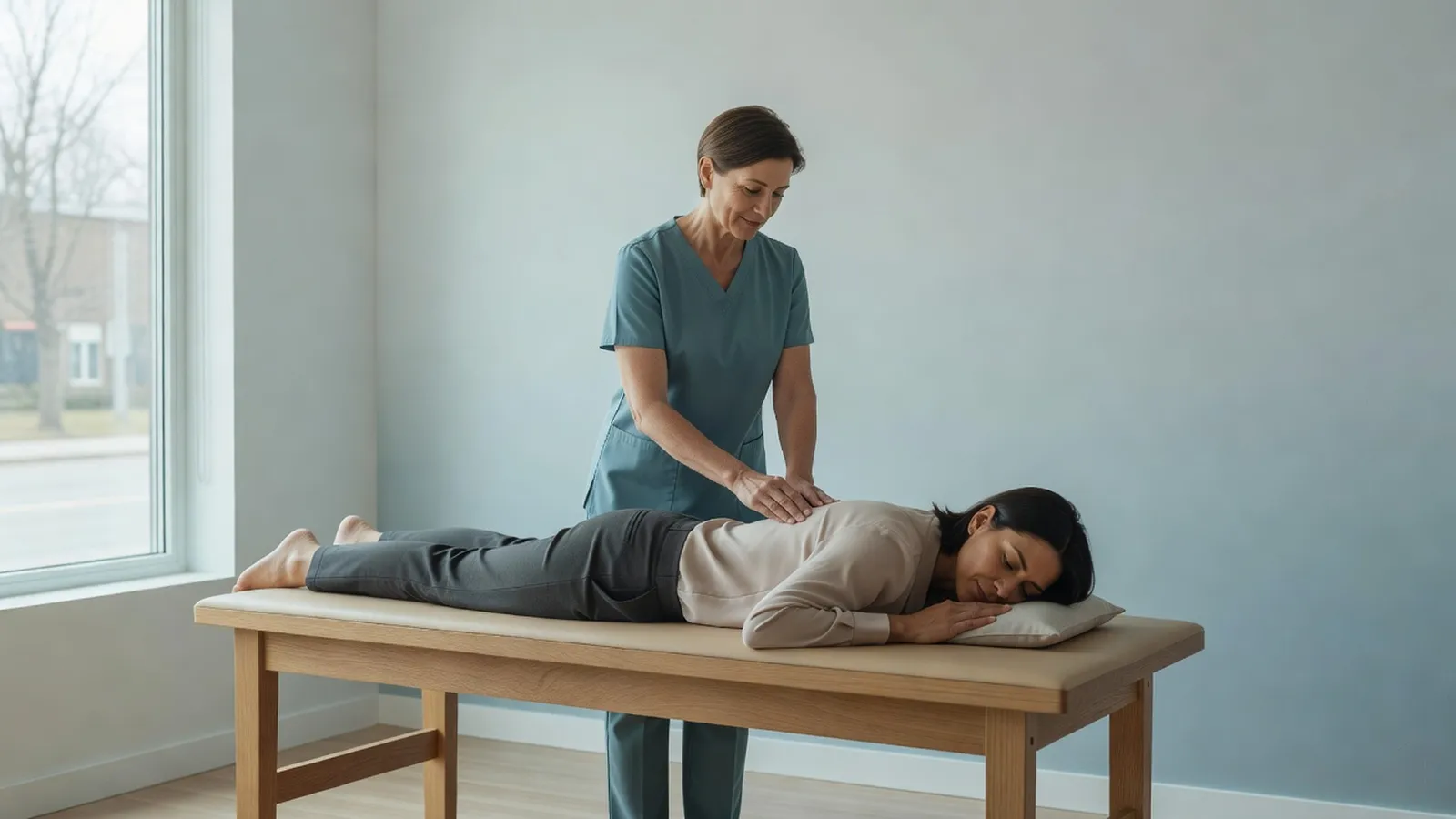
A Bowen session is usually quiet, clothed and unhurried: small rolling moves of the thumbs or fingers over muscle and connective tissue, interrupted by pauses during which you are left undisturbed. This guide explains what typically happens from the moment you book to the moment you leave, what the pauses are, what to say and ask, and what research can and cannot tell you about the method. It is general information, not advice about your own situation, and it promises no result.
Before you book: questions worth asking
A good session starts before you arrive. When you contact a practitioner, you can ask a few practical questions that will shape your expectations. How long is a first appointment, and what does it cost? Which school did the practitioner train with, and how long was the training? Does the practitioner also hold a regulated registration, such as massage therapy or physiotherapy, which you can verify in the public register of the provincial college? Our guide to the history of the Bowen technique explains why the training behind the label matters, since the Bowen technique, to our knowledge, is not a regulated profession with a protected title of its own.
Ask also about insurance. Extended health plans generally reimburse only the professions or associations they recognize, and a Bowen label by itself may not qualify. Checking with your insurer before booking avoids unpleasant surprises. If you have a medical condition, a recent injury or you are pregnant, mention it when you book, and consider speaking to your physician first. A responsible practitioner will welcome the question rather than treating it as an obstacle.
What to wear and what to bring
Descriptions of the method are consistent on one point: it is done through light clothing. Plan to wear something comfortable and not too thick, such as a soft top and loose trousers or leggings, so that the practitioner can feel the layers beneath the fabric. You will not normally be asked to undress. Shoes are often removed. If you wear a heavy sweater or a stiff belt, you may be asked to take it off, simply to let the moves land where they are intended.
Bring a short list of the reasons you are coming, the names of medications you take and any diagnoses you have been given. You do not need to bring a diagnosis to receive a gentle session, but the information helps the practitioner know when to suggest that you see a physician first. In a Canadian winter, arriving a few minutes early allows you to warm up and settle, which is useful for a method built around stillness.
The first conversation
Most first appointments begin with a conversation before anything else happens. The practitioner will usually ask about your health history, what brings you, any medical diagnoses and any treatment you are receiving. This is not a diagnostic examination, and a Bowen practitioner as such does not make a medical diagnosis. It is a way to understand your situation, to confirm that a gentle manual session is reasonable and to identify when a medical assessment should come first.
A careful practitioner will also set expectations. They will tell you plainly that the method does not replace medical care, will not ask you to stop a treatment prescribed by your physician, and will say that the research is limited. If a practitioner lists many conditions that the method is supposed to help, promises quick results or discourages you from seeing a doctor, treat that as a reason to ask more questions or to look elsewhere. The Competition Bureau of Canada lists miracle cures and dramatic personal stories among the warning signs of health and medical scams.
You can also use this conversation to agree on how the session will go: whether you will be lying on a table, sitting or standing, how you can signal discomfort, and whether you can stop at any time. Consent is not a single moment but something that continues through the session, and it is reasonable to say "pause" or "stop" whenever you wish.
The session itself: moves and pauses
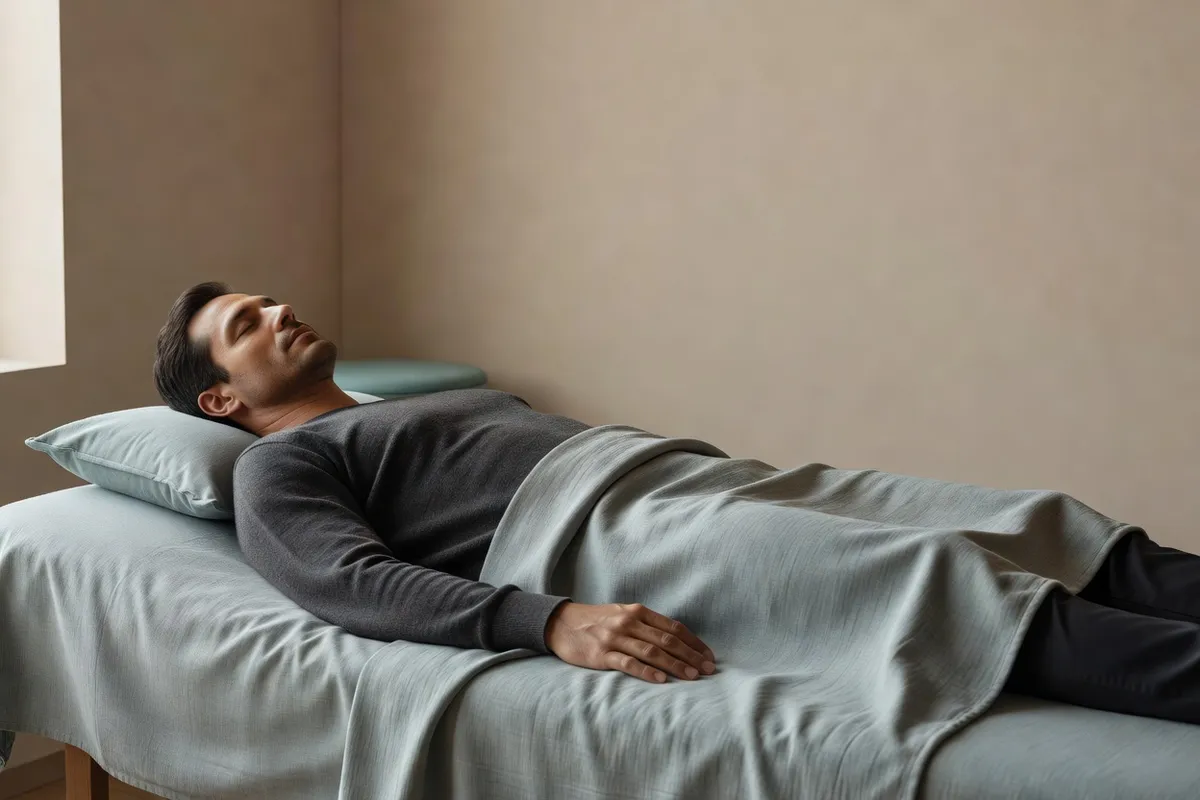
A Bowen session usually takes place on a treatment table, though some practitioners work with clients sitting or standing. You lie in comfortable clothing, often with a light blanket. The practitioner makes small, rolling moves with the thumbs or fingers over muscle, tendon or connective tissue at specific places on the body. The moves are brief and light compared with a deep-tissue massage; they are better described as a gentle pressure and release than as kneading.
The moves come in short sequences. After each sequence, the practitioner steps back or leaves the room for a few minutes so that you are left undisturbed. Some people find the quiet restful; others find it odd at first. You may feel warmth, heaviness, a pleasant drowsiness or nothing in particular, and all of these are described by clients. Because the touch is light, the method is generally regarded as low-risk for healthy adults, but low risk is not no risk, and individual situations differ.
| Stage | What typically happens | What to keep in mind |
|---|---|---|
| Intake | Questions about health history and reasons for coming | Mention medications and diagnoses |
| Set-up | Lying or sitting in light clothing | Ask how the session is arranged |
| Moves | Small rolling moves with thumbs or fingers | Report discomfort at once |
| Pauses | The practitioner steps back for a few minutes | Ask why pauses are used |
| Close | Short conversation and suggestions for the days after | Ask what to watch for and when to call a physician |
Why the pauses? What is claimed and what is known
The pause is the feature most people ask about. Schools give different explanations: that the body needs time to respond, that the nervous system integrates the stimulus, or that the practitioner is simply letting the session breathe. These explanations are hypotheses adopted by teaching schools, and none has been established by research. For a reader, it is enough to know that the pause is part of how the method is delivered and that it is reasonable to ask the practitioner what they believe and why.
It helps to separate two questions. The first is whether a pause makes a session feel calmer, which many people would say it does, since being left in a quiet room is restful in itself. The second is whether the pause has a specific physiological effect that explains an outcome, which is an empirical claim that requires careful study. The first question can be answered from experience; the second cannot be answered by anecdotes, however sincere. Our interview with an imagined Bowen practitioner shows how a careful practitioner talks about the pause without overstating what it does.
An hour in practice: a walk-through
To make the sequence concrete, imagine a first appointment of roughly an hour, with the caveat that practitioners differ. You arrive a few minutes early, hang up your coat and take a moment to settle. The practitioner greets you and sits with you for a conversation of perhaps ten minutes, asking about your reasons for coming, any diagnoses, medications, injuries and whether you have tried other approaches. They explain how the session will go and invite your questions. You are told that you can speak up, change position or stop at any moment.
You then lie on the table in your light clothing, perhaps with a blanket over you. The practitioner makes a short series of small rolling moves, then steps back or leaves the room. The quiet that follows can feel unusual at first, and many people close their eyes. After a few minutes the practitioner returns, makes another short series at a different place and withdraws again. This pattern of moves and pauses repeats several times. Nothing about it is hurried, and nothing about it needs your effort: you are not asked to breathe in a special way, to hold a posture or to perform an exercise.
At the end, you sit up slowly, since lying still for a while can leave you a little light-headed. The practitioner may offer a few general suggestions for the next day or two, such as drinking water and avoiding strenuous activity if you feel tired, and will usually tell you what they suggest as a next step, if any. This is the moment to ask what you should watch for and when you should contact a physician. Take a note of the conversation if you can, since a quiet session can leave the details a little hazy.
Situations that call for extra care
Gentle does not mean suitable for everyone in every situation. A few circumstances deserve a conversation with a physician before you book, or at least with the practitioner at the outset. These include pregnancy, a recent fracture or surgery, an acute injury, unexplained pain, a fever or infection, a bleeding disorder or the use of blood-thinning medication, and a history of conditions that affect the skin or circulation. This list is not exhaustive and it is not a set of rules; it is a reminder that a practitioner who knows your history can adapt or decline, and that a physician can tell you whether a manual approach is reasonable for you.
Children and older adults raise similar questions. A responsible practitioner will want to know the age and health situation of the person receiving the session, and will adapt the approach or suggest a medical assessment first when appropriate. If a practitioner states that the method suits everyone and every complaint, that is a signal to look more closely rather than a reassurance.

It is also worth saying that unexplained or worsening symptoms are not something to bring to a manual therapist first. Sudden severe pain, loss of strength or sensation, difficulty with bladder or bowel control, chest pain, shortness of breath, fever with back pain or a headache unlike any you have had are reasons to seek medical care promptly. A gentle session cannot assess these, and waiting for it to help can delay the care you need. Our guide to chronic pain lists questions to bring to a physician when pain persists, and the article on choosing a manual-therapy practitioner explains how colleges, titles and warning signs fit together.
How long a session lasts and how many you might have
Sessions are often described as lasting under an hour, though the length varies with the practitioner and the school. How many sessions are suggested is also variable. In the 2023 randomized trial of a Bowen-based method for myofascial neck pain, participants received eight sessions over twelve weeks and were compared with people receiving usual conventional care; that was a research protocol designed to answer a specific question, not a recommendation for anyone's care.
For an individual, the sensible approach is to ask the practitioner how they decide on a number of sessions, what they would expect to see by a certain point, and what they would do if nothing changed. A trustworthy answer includes an honest willingness to stop. Be cautious about prepaid packages of many sessions, and about any pressure to continue when you have not noticed a benefit. You can always book one session, see how you feel and decide afterwards.
What you might notice afterwards, and what to do
After a session, people describe a range of experiences: feeling relaxed, sleepy, a little tired, lightly sore in places, or simply unchanged. These reports are common but not universal, and they are not evidence that the method has a particular effect. They are also the kind of experience that can follow any quiet hour spent lying down with someone paying attention to you.
Practitioners often suggest drinking water and taking it easy for a day or so. These are general comfort suggestions rather than treatment instructions. If you feel unwell afterwards, if pain increases or if you notice new symptoms such as numbness, weakness, chest pain, fever or severe headache, contact a physician. Do not wait for the symptoms to be explained by the session, and do not hesitate to say so to the practitioner at your next visit.
What the research says about the method
The research on the Bowen technique is limited. A systematic review by Hansen and Taylor-Piliae, published in 2011, identified 309 citations and kept 15 articles; only one was a randomized clinical trial. The authors concluded that the method may be a non-invasive complementary approach but that the scientific evidence was not well documented. A few randomized trials have appeared since, including a 2023 trial of a Bowen-based method for myofascial neck pain involving 90 people and a 2024 trial comparing the technique with a muscle energy technique in 62 people with chronic low back pain and hamstring tightness. Each had a particular design, population and outcome, and none settles the question for a given condition.
When you read about the method, keep three cautions in mind. A study that finds a difference in a measurement, such as flexibility, does not always show a difference in how a person feels or functions. A trial that compares the method with doing nothing cannot separate the method itself from the benefit of being cared for and expecting to feel better. And small samples and short follow-up are common in manual therapy research. Our article on what the research actually shows goes through these issues in more detail, and our overview of the Bowen technique places the method in context.
Choosing a practitioner and knowing when to stop
Because the technique is not a regulated profession with its own title, choosing a practitioner calls for a few sensible checks. A government information service in Victoria, Australia, publishes a page on Bowen therapy that advises choosing a registered therapist, a practical note that applies in Canada as well. Look for a practitioner who is open about their training, holds a regulated registration you can verify, describes the method in modest terms and answers your questions without defensiveness. In British Columbia, the College of Complementary Health Professionals lists the reserved titles for massage therapy, which helps you tell a regulated title from a label that anyone can use.
You are free to stop at any time. If a session is uncomfortable, if you do not like how you are being treated, or if you simply feel it is not for you, you can end the session or decline to return. A good practitioner will respect that.
What to take away
A Bowen session is, at its simplest, a quiet hour of light, rolling touch interrupted by pauses. It is generally described as gentle, it is done through light clothing and it is best approached as a complementary experience, with a clear view of what you are paying for. The method has not been shown by research to be effective for a specific condition, it does not replace medical care and its pauses are explained by schools in ways that research has not confirmed.
If you decide to try it, ask about training and registration, mention your health history, expect modest claims, speak up if anything is uncomfortable and keep your physician informed. If your symptoms are new, severe or unexplained, see a physician first. That is the practical core of this guide, and it holds whatever you decide.
Frequently asked questions
Do I have to undress for a Bowen session?
No. Sessions are usually described as taking place through light clothing, so you do not undress, although you may be asked to remove shoes or bulky layers. If you are unsure, ask how the session is set up when you book. You can always say that you prefer to keep a particular layer on.
Why does the practitioner leave the room?
After a short sequence of moves, practitioners commonly step back or leave for a few minutes so that you are undisturbed. Schools explain this pause in different ways, and no explanation has been established by research. You can ask the practitioner what they do during pauses and why they use them.
How many sessions will I need?
There is no universal number. In a 2023 randomized trial of a Bowen-based method for neck pain, participants received eight sessions over twelve weeks, but that was a research protocol, not a recommendation. Ask the practitioner to explain how they decide on a number and how you can stop at any time.
Is a Bowen session painful?
The touch is generally described as light, much lighter than a deep-tissue massage. If anything feels uncomfortable, say so immediately so the practitioner can adjust or stop. Discomfort that is sharp, new or lasting is a reason to pause and consider seeing a physician.
Can I use it instead of medical care?
No. The method is not a diagnostic tool and does not replace medical assessment, medication, physiotherapy or psychotherapy when these are indicated. Do not stop a prescribed treatment without discussing it with the prescriber, and see a physician for symptoms that are sudden, severe or unexplained.
Sources
Verified on
- Better Health Channel, Bowen therapy, Gouvernement de l'État de Victoria, Australie, 2026.
- Chee LAY et al., The effect of ISBT-Bowen therapy in the treatment of myofascial neck pain: a randomized, single-blinded clinical trial, International Journal of Therapeutic Massage and Bodywork, 2023.
- Batool K, Mehmood M et al., Comparative efficacy of muscle energy technique and Bowen technique on hamstrings muscle tightness in chronic low back pain patients, Pakistan Journal of Medical Sciences, 2024.
- Hansen C, Taylor-Piliae RE, What is Bowenwork? A systematic review, The Journal of Alternative and Complementary Medicine, 2011.
- Marr M, Baker J, Lambon N, Perry J, The effects of the Bowen technique on hamstring flexibility over time: a randomised controlled trial, Journal of Bodywork and Movement Therapies, 2011.
- Bowen Therapy Professional Association (Royaume-Uni), About Tom Bowen, Association de praticiens (source secondaire d'histoire), 2026.
- HealthLink BC, College of Health and Care Professionals of BC, Government of British Columbia, 2026.