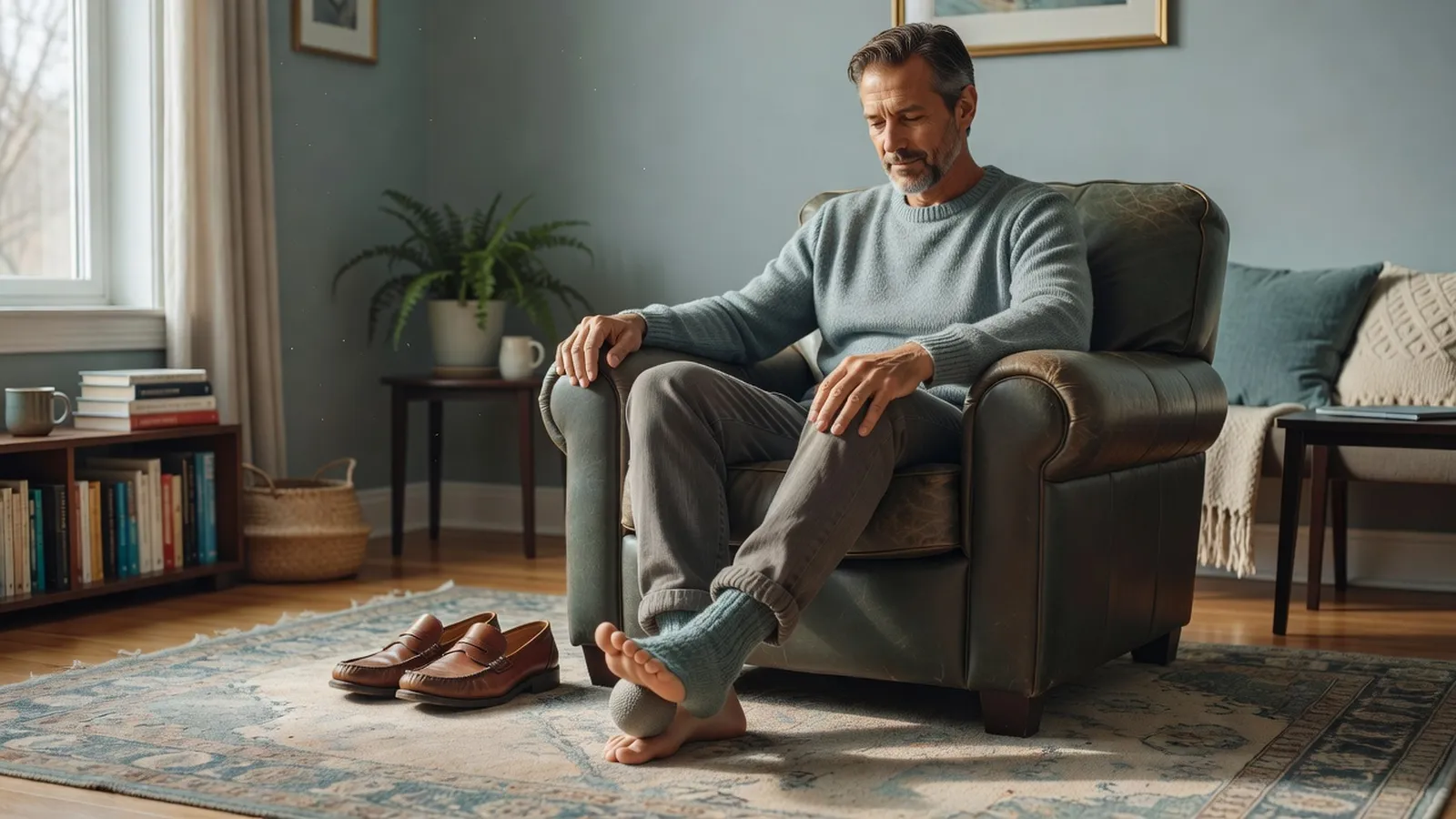
Neck, knees and feet carry a great deal of daily load, and when they ache, people often look for something gentle to try at home before booking an appointment. This article looks at what published reviews and guidelines say about exercise and self-care for these three areas, what we could and could not verify, and how to think about "reasonable to try" without turning it into a protocol. It gives no exercises, doses or programmes. It is general information, not advice about your own body, and it promises no result.
What "gentle self-care" can and cannot mean
The phrase gentle self-care is attractive because it sounds safe and within your control. It is worth being clear about what it can mean here. It can mean paying attention to how you move, sit, stand and walk. It can mean choosing footwear that you find comfortable, pacing activities rather than doing too much at once and staying active in ways that are within your comfort. It can also mean talking with a physician or physiotherapist about what is reasonable for you, which is often the most useful form of self-care.
What it cannot mean is self-diagnosis or a do-it-yourself treatment plan. Neck pain, knee pain and heel pain each have many possible causes, some trivial and some needing assessment, and a general article cannot tell which applies to you. For that reason, we describe the research and the principles, not routines. If you are looking for guidance on how to move more in everyday life, our guide to movement and posture gives the wider context, and the pages below show how self-care fits with medical care.
Neck: what a Cochrane review reports about exercise
For neck pain that is mechanical, meaning not caused by an identified disease or injury, a Cochrane review by Gross and colleagues, titled "Exercises for mechanical neck disorders" and published in 2015, gathered randomized trials of active exercises. According to the Cochrane summary, the exercises examined included specific neck and shoulder exercises, stretching, strengthening, postural, breathing, cognitive, functional, eye-fixation and proprioception exercises. The trials covered neck pain of different durations, with chronic neck pain the most common.
The summary states that results showed exercise is safe, with temporary and benign side effects, although more than half of the trials did not report on adverse effects. That statement is useful, and it also shows a limit of the evidence: when adverse effects are not reported, safety is less certain than it sounds. We do not quote effect sizes here, since the point of this article is not to promise a result but to describe what the evidence base looks like. In general terms, active exercise has been studied for neck pain more than most other approaches, and clinicians often discuss it as part of a plan.
What the review cannot tell you is which exercise is right for you, how often to do it or whether your neck pain is of the mechanical kind. That is a conversation for a clinician. For readers who work at a desk, our article on desk and remote-work posture through a Canadian winter looks at everyday habits that may be worth reviewing.
Knees: exercise and osteoarthritis
For knee osteoarthritis, a Cochrane review by Fransen and colleagues, "Exercise for osteoarthritis of the knee", was published in 2015 and is often cited in clinical discussions. We verified the reference through Crossref, but the full text of the review was not readable by automated means at the time of our consultation, so we do not quote its figures or its detailed conclusions.
In general terms, exercise is commonly discussed in guidelines for knee osteoarthritis, and the Arthritis Society of Canada publishes material on exercise for arthritis. What matters for a reader is that exercise for knee pain is typically discussed with a clinician, often a physiotherapist, who can take into account the diagnosis, the stage of the condition and other health issues. Knee pain can also arise from injury, from other joint problems or from conditions that need medical attention. If your knee is swollen, hot, locking, giving way or painful after a fall, see a physician.
Everyday self-care for knees tends to concern the same few themes that people mention with clinicians: how much walking and stair use are comfortable, footwear, body weight as a topic that some people choose to discuss with their physician, and how to stay active without flaring pain. We do not give specifics. Our guide to chronic pain lists questions to bring to an assessment when pain persists.
Feet and heels: guidelines on heel pain
Heel pain, often called plantar fasciitis when it affects the underside of the heel, is the subject of a clinical practice guideline, "Heel Pain: Plantar Fasciitis: Revision 2014", published by Martin and colleagues in the Journal of Orthopaedic and Sports Physical Therapy. As with the knee review, we verified the reference but could not read the full text by automated means, so we do not reproduce its recommendations.
What we can say in general terms is that guidelines of this kind exist and that they tend to discuss stretching, footwear and activity changes, among other topics, usually with the aim of helping a clinician to decide what to suggest. If you have heel pain, a sensible first step is a conversation with a physician, a physiotherapist or a podiatrist, depending on what is available where you live, rather than assembling a routine from the internet. If the pain follows an injury, if you cannot put weight on the foot or if there is swelling, redness or numbness, seek care promptly.
| Area | What published sources exist | What we verified | What we do not say |
|---|---|---|---|
| Neck | Cochrane review of exercises for mechanical neck disorders (2015) | Reported as safe with temporary, benign side effects | Which exercise, how often, for whom |
| Knees | Cochrane review of exercise for knee osteoarthritis (2015) | Reference verified; full text not readable | Any figure or detailed conclusion |
| Heels | Clinical practice guideline on plantar fasciitis (2014) | Reference verified; full text not readable | Any specific recommendation |
Where exercise fits with the rest of your health
Exercise has benefits that go beyond a single sore joint. The Canadian 24-Hour Movement Guidelines for adults aged 18 to 64, from the Canadian Society for Exercise Physiology, recommend at least 150 minutes of moderate to vigorous physical activity per week, muscle-strengthening activities at least twice a week, several hours of light activities including standing and 7 to 9 hours of good-quality sleep with consistent bed and wake-up times, while limiting sedentary behaviour. These are population guidelines, not individual prescriptions, and they may not suit someone in pain; a clinician can help to interpret them for you. They do illustrate that movement and sleep are part of the same picture. Our overview of stress and sleep discusses sleep in general terms.
A systematic review by Shiri and colleagues, published in 2018, found that exercise reduced the risk of low back pain in controlled trials, which is a different question from treating existing pain but shows why guidelines tend to emphasize staying active. As always, a general finding does not tell you what to do about your own symptoms.
Everyday habits worth noticing
Beyond exercise, a few everyday habits are worth noticing because they come up in conversations with clinicians. How long do you stay in the same position at a desk or in a car? Do your shoes feel comfortable for the surfaces you walk on? Do you carry a bag on one shoulder? Do you change position during the day? These questions are not diagnoses, and the answers do not predict whether you will have pain. They are prompts for self-observation that make an appointment more productive.
Keeping a simple note of when your pain is better or worse, what you were doing and what seemed to help can be more informative than a general impression. Bring it to your appointment, and do not hesitate to say what worries you. Our interview with an imagined ergonomist on moving more during the workday illustrates the kind of conversation about daily habits that can be useful.
Questions to bring to a physician or physiotherapist
A short list of questions can make an appointment about neck, knee or heel pain more useful. What do you think is causing my pain, and how did you reach that view? Is any test or imaging needed, and what would it change? What movement or activity is reasonable for me now, and what should I avoid for the moment? How will we know whether something is helping, and over what time frame? What would make you want to see me sooner, or refer me to someone else? Is there anything about my work, my shoes or my daily routine that is worth changing?
It is also fair to ask where a suggestion comes from. A clinician who recommends exercise can usually say what kind of evidence supports it, in plain words. The Canadian 24-Hour Movement Guidelines published by the Canadian Society for Exercise Physiology are one example of a public reference that clinicians use to discuss general activity, and they can serve as a starting point for a conversation about how a general guideline applies, or does not apply, to someone with pain.
Do not be discouraged if the first answer is "it depends". For many musculoskeletal complaints, clinicians reassess after a period of time, because the course of the problem helps to clarify what is going on. A plan that includes a review date is a good sign, and so is a clinician who invites you to report back if something changes.

A caution about "correct posture" and quick fixes
Advice about posture and alignment is everywhere, and much of it is stated with more confidence than the evidence supports. It is common to read that a certain position is "correct" and that deviations cause pain. The reality is more nuanced: people vary, tolerance for a given posture differs and the best posture is often described as the next one, meaning that changing position regularly matters more than holding any single position. We therefore avoid prescribing positions or alignments here.
The same caution applies to devices and gadgets marketed as fixes for neck, knee or foot pain. Some may be comfortable or useful for particular people, and some are expensive without good evidence. Ask what the claim is based on, whether it has been studied, and what the return policy is. A clinician may be able to say whether a device is reasonable for your situation, and some products are better discussed before buying than after.
Finally, be wary of quick-fix language, such as "instant relief", "permanent correction" or "one simple trick". Pain that has lasted weeks or months rarely has a one-step solution, and the claim is usually a sign that the seller is promising more than a clinician would. The Competition Bureau of Canada lists miracle cures and dramatic personal stories among the warning signs of health and medical scams.
A day in the life: noticing without prescribing
To make the idea of everyday habits concrete without turning it into a routine, consider a person who works at a desk, walks to the bus in winter boots and cooks dinner standing up. Their neck, knees and feet are each asked to do different things at different times. At the desk, they might notice that the neck feels tense by mid-afternoon; in the boots, that the heels ache after the walk; at the stove, that the knees feel stiff after standing. Noticing these patterns does not tell them what to do, but it gives them something specific to describe to a clinician.
A good conversation might then cover whether the boots are suitable for the distance, whether there are moments in the day when changing position is easy, and whether anything about the workstation could be adjusted. These are the kind of everyday questions that an ergonomist, a physiotherapist or a physician can discuss, and they do not require anyone to adopt a routine from an article. For more on workplace habits, see our interview with an imagined ergonomist.
Seasonal conditions matter in Canada. Cold weather, ice and snow change how people walk, how long they are active and what they wear on their feet. If ice or snow makes you uneasy about falling, that is worth taking seriously, and it is reasonable to ask a clinician about it. Safety on slippery surfaces is an important topic, and one that general articles cannot resolve for an individual.
Where manual approaches fit
Some people combine self-care with a manual session, such as massage, because they find it relaxing. Research on manual approaches to pain is more limited than research on exercise, and the results of reviews are generally modest and of low quality. A manual session can be a comfort, but it is a complement to movement and medical care, not a replacement for them. If you choose one, tell the practitioner about your symptoms, ask what they can and cannot offer and be wary of promises to treat or cure a condition. Our article on choosing a manual-therapy practitioner in Canada explains how colleges, titles and warning signs fit together.
When to see a physician first
Self-care is not for every situation. See a physician for pain that is new, severe, persistent or unexplained, for pain after an injury or a fall, and for pain that comes with numbness, tingling, weakness, fever, swelling, redness or heat. Night pain that wakes you, pain that limits walking or daily activities, unexplained weight loss, loss of control of the bladder or bowel, chest pain or shortness of breath are reasons to seek care promptly. The neck, knees and feet are also places where symptoms of other conditions can appear, which is why an assessment matters.
If you are uncertain, it is reasonable to call a health line or a clinic and ask whether your symptoms warrant an assessment. It is better to ask and be reassured than to wait with something that needed attention.
A last practical point: change one thing at a time. If you adjust your shoes, your desk and your activity level all in the same week, you will not know which change made a difference, or which one caused a new ache. Small, separate changes, with a note of what you noticed, make it easier to tell a clinician what happened and to decide together what to keep.
What to take away
For neck pain, a Cochrane review reports that exercise is safe, with temporary and benign side effects, across many types of exercise. For knees and heels, reviews and guidelines exist, but we could not read their full texts and give no figures. None of this amounts to a protocol, and this article gives no exercises or doses. Gentle self-care is a reasonable thing to discuss with a physician or physiotherapist, not a substitute for assessment.
If you are considering something new, introduce it gradually, notice how you respond, stop if pain increases or new symptoms appear and tell your clinician what you are doing. If your symptoms are new, severe or unexplained, see a physician first.
Frequently asked questions
Is gentle exercise safe for neck pain?
A Cochrane review of exercises for mechanical neck disorders (Gross and colleagues, 2015) reports that exercise is safe, with temporary and benign side effects, although more than half of the trials did not report on adverse effects. That is general evidence, not a plan for you; a clinician can advise what suits your situation.
Do you give exercises for knees or feet?
No. This article gives no exercise programme, dose or protocol, because what suits one person may not suit another and because the right approach depends on the cause. We describe what reviews and guidelines exist and how to discuss self-care with a physician or physiotherapist.
What counts as reasonable self-care?
In general terms, gentle movement within comfort, paying attention to footwear and everyday habits, and changing activities gradually, discussed with a clinician if pain persists. We avoid specifics. If something increases your pain or causes new symptoms, stop and seek advice.
When should I see a physician instead of trying self-care?
See a physician for pain that is new, severe, persistent or unexplained, pain after an injury, pain with numbness, weakness, fever, swelling or redness, pain at night that wakes you, or pain that limits walking or daily activities. Self-care is not a substitute for assessment.
Can a massage or manual session replace self-care or exercise?
Not on the evidence we cite. Reviews of exercise have been published for neck pain, knee osteoarthritis and heel pain, while research on manual approaches is more limited. A manual session can be a comfort, but it is a complement to movement and medical care, not a replacement.
Sources
Verified on
- Gross A, Kay TM, Paquin JP et al., Exercises for mechanical neck disorders, Cochrane Database of Systematic Reviews, 2015.
- Fransen M, McConnell S, Harmer AR et al., Exercise for osteoarthritis of the knee, Cochrane Database of Systematic Reviews, 2015.
- Martin RL, Davenport TE, Reischl SF, McPoil TG et al., Heel Pain: Plantar Fasciitis: Revision 2014, Journal of Orthopaedic & Sports Physical Therapy, 2014.
- NCCIH, Complementary Health Approaches for Chronic Pain, National Center for Complementary and Integrative Health (NIH), 2026.
- Shiri R, Coggon D, Falah-Hassani K, Exercise for the prevention of low back pain: systematic review and meta-analysis of controlled trials, American Journal of Epidemiology, 2018.
- SCPE / CSEP, Canadian 24-Hour Movement Guidelines for Adults (18-64), Société canadienne de physiologie de l'exercice, 2026.